News
Wall Street: The Week Ahead — Investors Eye Bank Earnings Amid Data Blackout

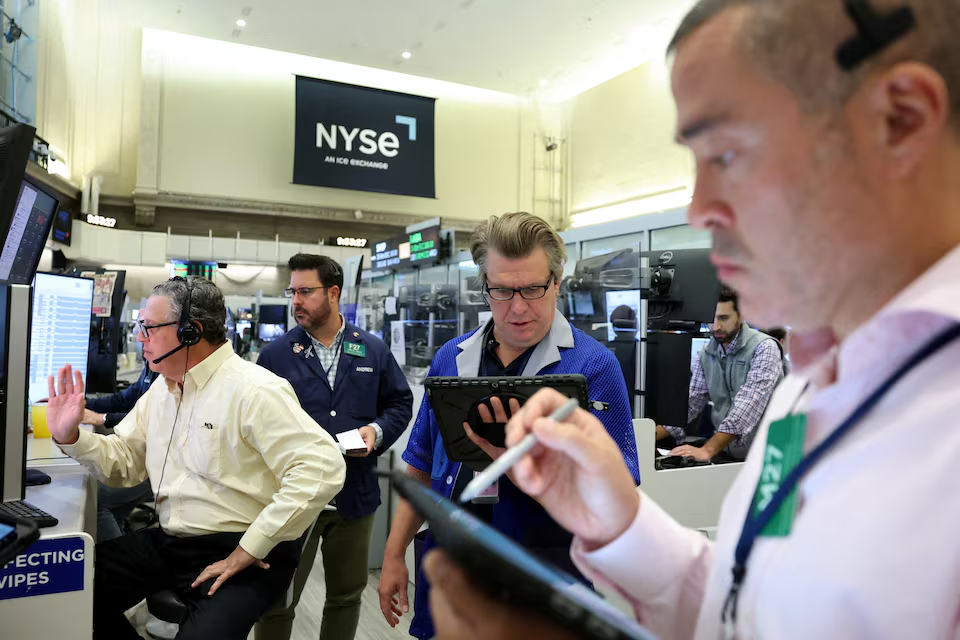
Investors will be watching major bank earnings reports in the coming week to gauge the health of the U.S. economy, as the flow of new government data remains disrupted by the federal shutdown.
U.S. equity markets ended the week on a subdued note Friday, with major indexes falling after President Donald Trump’s comments reignited trade tensions with China. The pullback came just before the benchmark S&P 500 (.SPX) marks the third anniversary of its current bull market run on Sunday.
“The market had become overbought, so some volatility was expected,” said Matthew Miskin, co-chief investment strategist at Manulife John Hancock Investments. “Ultimately, it’s going to come back to the economy and to corporate profits—and earnings season is just around the corner.”
With valuations near five-year highs and growing concern that investor enthusiasm for technology and artificial intelligence may be overheating, a strong third-quarter earnings season will be crucial to sustaining momentum. Despite Friday’s dip, the S&P 500 remains up more than 11% for the year and within 3% of its all-time high.
“The market continues to grind higher, supported by a solid earnings outlook,” said Garrett Melson, portfolio strategist at Natixis Investment Managers Solutions. “Fundamentally, things still look good.”
Alongside record-breaking equity gains, gold, silver, and bitcoin have also rallied sharply in recent weeks. Top financial leaders—including IMF Managing Director Kristalina Georgieva and JPMorgan CEO Jamie Dimon—have issued cautious remarks about market froth.
JPMorgan (JPM.N) will kick off the earnings season on Tuesday, followed by Goldman Sachs (GS.N), Wells Fargo (WFC.N), and Citigroup (C.N). Bank of America (BAC.N) and Morgan Stanley (MS.N) are set to report Wednesday.
Recent signs of weakness in the labor market have renewed concerns about growth and pushed the Federal Reserve to resume interest rate cuts.
“Banks are a window into the U.S. economy,” said Irene Tunkel, chief U.S. equity strategist at BCA Research. “If we see consumers still spending and loan demand improving, that would suggest we’re not really heading into a contraction.”
Other companies reporting next week include healthcare giant Johnson & Johnson (JNJ.N) and asset manager BlackRock (BLK.N). According to LSEG I/B/E/S, S&P 500 companies’ overall earnings are expected to rise 8.8% from a year earlier in the third quarter.
“Most of the rally has been built around expectations of strong earnings growth,” said Chuck Carlson, CEO of Horizon Investment Services. “If we start to see cracks in that story, that could spell trouble for the market as a whole.”
Attention will also remain on Washington, where Republicans and Democrats continue efforts to break the deadlock and end the government shutdown that began on October 1. So far, markets have largely shrugged off the shutdown, though analysts warn that the longer it drags on, the greater the economic risk—already disrupting U.S. travel and other activities.
Another concern for investors is the delay in key government economic reports. The monthly employment report, initially due October 3, has already been postponed.
Investors fear the shutdown could affect next week’s data releases as well, including inflation and retail sales figures.
The Bureau of Labor Statistics said Friday that the Consumer Price Index report—closely watched for inflation trends—will now be released on October 24, instead of this Wednesday. While the CPI report will allow the Social Security Administration to meet its benefit payment deadlines, the BLS said no other reports will be issued or rescheduled until regular government operations resume.
“If the shutdown continues into next week, it could also delay the release of October’s jobs report, making data interpretation increasingly difficult,” wrote Michael Pearce, deputy chief U.S. economist at Oxford Economics, in a Friday note.
“With most regular economic statistics unavailable during the shutdown,” he added, “the data fog is deepening.”