News
National Guard Begins Patrols Near Chicago as Two Courts Weigh Trump’s Deployment Orders

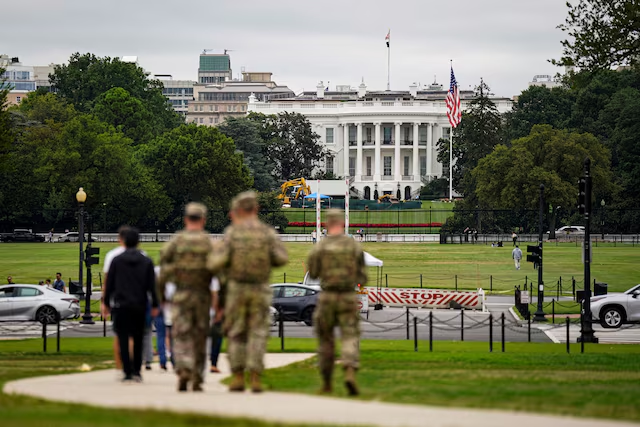
Courts in Illinois and Oregon are set to hear challenges from Democratic governors over President Donald Trump’s deployment of National Guard troops to their states, even as soldiers began patrolling near a Chicago-area immigration center that has become a focal point of ongoing protests.
A federal judge in Illinois will decide whether to temporarily block the Guard’s deployment in Chicago, while a California appeals court will review a lower court’s injunction that halted Trump’s decision to send troops to Portland, Oregon.
On Thursday morning, around seven or eight armed National Guard soldiers were seen inside the gates of an Immigration and Customs Enforcement (ICE) facility in Broadview, Illinois, though they were not carrying rifles, shields, or other riot gear.
The ICE center, operated by U.S. Immigration and Customs Enforcement, has been the site of frequent demonstrations since last month’s increase in federal immigration enforcement. ICE officers have previously used pepper balls, tear gas, and rubber bullets to disperse protesters.
Amid legal battles, the Trump administration deployed about 500 National Guard troops—including several hundred from Texas—to the Chicago area.
National Guard units, while wearing U.S. Army uniforms, are state-controlled militia forces that typically answer to their governors. The President can assume command only under limited circumstances, usually during national emergencies. Traditionally, they are mobilized for disaster relief operations.
A coalition of 24 states filed a brief on Wednesday supporting Oregon and California’s lawsuits against the Portland deployment, urging the appeals court to uphold the lower court’s decision. The states argued that Trump’s move violates the U.S. Constitution, undermines state sovereignty, and endangers local communities.
Trump has defended the deployments, saying the troops are needed to protect federal ICE officers from threats posed by demonstrators and Democratic officials who have refused to cooperate with the White House. Democratic governors and mayors, in turn, accuse the President of manufacturing a political crisis for electoral gain.
Trump now faces four separate lawsuits over his troop deployments in Portland, Los Angeles, Washington D.C., and Chicago. Two lower courts have already ruled against the deployments, with judges finding no justification for military intervention in the largely peaceful protests in Los Angeles and Portland.
However, the same appeals court that will hear the Portland case previously overturned a California ruling against Trump, stating that the President’s military decisions should be granted broad deference.
Trump officials have characterized the anti-immigration raids protests as violent, though most demonstrations have remained small and peaceful, especially compared to the mass protests that erupted nationwide in 2020 following the killing of George Floyd by Minneapolis police.
Outside the Broadview ICE detention center on Wednesday evening, about a dozen protesters gathered—smoking, vaping, and eating burgers—as they awaited the arrival of Guard troops from Illinois and Texas.
Many expressed concern that the soldiers’ presence could heighten tensions.
“I think I’m ready to take a live round,” said Will Kratz, 22, a Chicago administrative assistant whose body still bears marks from pepper-ball rounds. “If I survive this and can look back knowing I did something while something terrible was happening, I’ll be able to sleep peacefully.”
Later that evening, hundreds of people marched through downtown Chicago to protest the deployment.
The rally also echoed anger over the fatal shooting of immigrant Silverio Villegas González by ICE agents in a Chicago suburb last month, with demonstrators chanting, “Todos somos Silverio”—“We are all Silverio.”
Police presence at the event was minimal, and there were no visible signs of federal agents.

Continue Reading