News
Russia Moves to Withdraw from Plutonium Deal with the United States

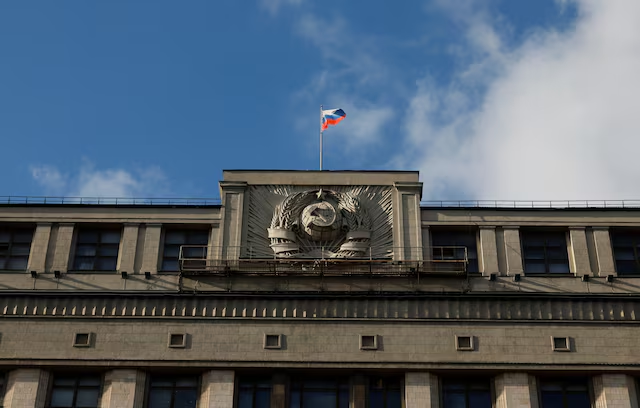
Russia’s lower house of parliament on Wednesday approved a proposal to withdraw from a landmark agreement with the United States aimed at reducing vast stockpiles of weapons-grade plutonium left over from the thousands of nuclear warheads built during the Cold War.
Under the Plutonium Management and Disposition Agreement (PMDA), signed in 2000, both the U.S. and Russia committed to disposing of at least 34 metric tons of weapons-grade plutonium — enough to make roughly 17,000 nuclear weapons, according to U.S. officials. The accord entered into force in 2011.
A note accompanying the Russian legislation withdrawing from the deal stated: “The United States has taken a series of new anti-Russian actions that have fundamentally altered the strategic balance that existed at the time of the agreement and have created additional threats to strategic stability.”
Following the dismantling of thousands of nuclear warheads after the Cold War, both Moscow and Washington were left with large quantities of weapons-grade plutonium, which was expensive to store and posed proliferation risks.
The PMDA was designed to neutralize that material by converting it into safer forms — such as mixed oxide (MOX) fuel — or by irradiating it in fast-neutron reactors for electricity generation.
Russia suspended implementation of the agreement in 2016, citing U.S. sanctions, what it called unfriendly actions by Washington, NATO’s expansion, and changes in the way the U.S. planned to dispose of its plutonium.
At the time, Moscow accused Washington of violating the accord by diluting its plutonium for disposal without Russia’s approval, instead of following the jointly agreed method.
Russia and the United States remain the world’s largest nuclear powers, together possessing around 8,000 nuclear weapons — a sharp decline from the 73,000 warheads that existed at the peak in 1986, according to the Federation of American Scientists.