News
The Longest Government Shutdowns in U.S. History

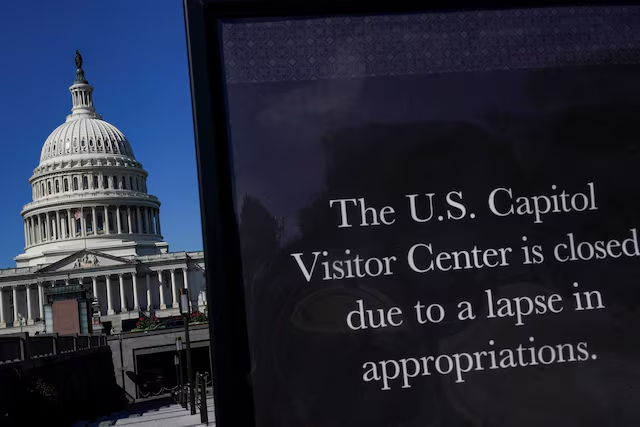
A budget deadlock in Congress forced thousands of U.S. federal employees to stop work on Wednesday, marking the longest government shutdown since 1980—when federal agencies first began furloughing employees after funding lapsed.
2018–2019 — 35 Days
The longest shutdown on record began on December 22, 2018, during President Donald Trump’s first term. The standoff arose when Democrats refused to back a spending bill that included $5.7 billion for Trump’s proposed wall along the U.S.–Mexico border.
After weeks of negotiations, lawmakers ultimately approved a spending package without border wall funding, which Trump signed into law on January 25, 2019, ending the 35-day shutdown.
1995–1996 — 22 Days
A partial shutdown began on December 16, 1995, due to a clash between the Republican-controlled Congress and Democratic President Bill Clinton over how to balance the federal budget.
Clinton signed a bill to reopen the government on January 6, 1996. Polls later showed the public largely blamed congressional Republicans for the impasse — an outcome many analysts believe helped Clinton win re-election later that year.
2013 — 16 Days
On October 1, 2013, federal employees were furloughed after Republicans demanded cuts or delays to the Affordable Care Act (Obamacare), backed by Democratic President Barack Obama.
The shutdown was part of a broader standoff over raising the national debt ceiling, with the U.S. at risk of defaulting on its obligations. Obama signed a bill just after midnight on October 17 to reopen the government and authorize additional borrowing.
1995 — 6 Days
The first of two shutdowns in 1995 began on November 14, after Clinton vetoed a Republican-backed spending bill. A temporary agreement allowed the government to reopen on November 19, though another shutdown followed weeks later amid ongoing budget disputes.
2025 — 4 Days (Ongoing)
The current shutdown, now the fifth longest, stems from a standoff in the Republican-led Congress. Democrats have blocked a spending bill, insisting that any funding package must also include an extension of pandemic-era healthcare subsidies set to expire at the end of December.
Republicans argue the subsidy issue should be addressed separately.
1990 — 3 Days
A dispute over deficit-reduction measures led Republican President George H.W. Bush to veto a spending bill, triggering a partial shutdown on October 6, 1990. National parks and historic sites were closed until lawmakers passed a bill to reopen the government on October 9.
2018 — 3 Days
A brief shutdown began on January 20, 2018, when Democrats in the Republican-controlled Congress blocked a spending bill, partly to protect “Dreamers” — young immigrants brought to the U.S. illegally as children — from deportation.
Congress passed a measure to reopen the government on January 22, though the fate of the Dreamers remained unresolved.