News
Japan’s Sanae Takaichi Promised Nordic-Level Female Representation in Cabinet — Can She Deliver?

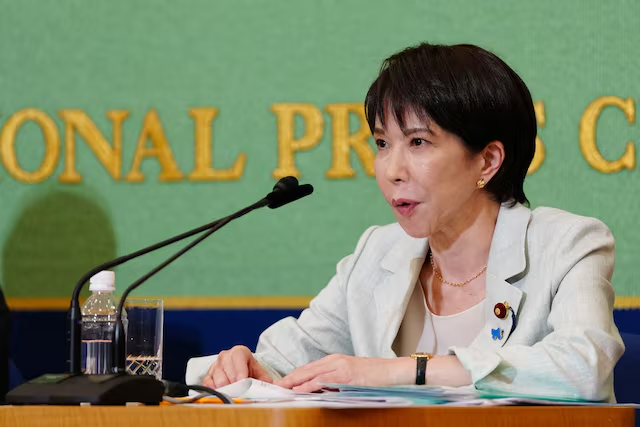
In her campaign to become Japan’s first female prime minister, Sanae Takaichi made a bold pledge to narrow the country’s wide gender gap in politics and raise the number of women in her Cabinet to levels seen in socially progressive Nordic nations.
Now, having defied the odds to win the leadership of the ruling Liberal Democratic Party (LDP) on Saturday — putting her on course to follow in the footsteps of her idol, Margaret Thatcher, the U.K.’s first female prime minister — Takaichi faces the challenge of fulfilling promises her party has long struggled to meet.
“The emergence of a woman leader alone will not significantly improve women’s status in politics,” said Professor Tohko Tanaka, a gender studies scholar at the University of Tokyo, noting that it took Britain 26 years after Thatcher to elect another woman, Theresa May, as prime minister.
A Cabinet with Few Women
Tanaka said Japan’s next leader must tackle gender inequality with a long-term vision amid a severe labor shortage and persistently low female participation. In the World Economic Forum’s Global Gender Gap Report, Japan ranks 118th out of 148 countries, the lowest among the G7 industrialized nations.
Though gender equality was not a central theme in the LDP’s leadership race — which largely focused on inflation and immigration — Takaichi vowed to form a Cabinet with female representation “no less than that of the Nordic countries.”
“I will not appoint women simply because they are women,” she told supporters at a rally last week. “But I plan to select more women who are capable and willing to serve the nation.”
Currently, only 10% of outgoing Prime Minister Shigeru Ishiba’s 20-member Cabinet are women, with the historical peak being just over a quarter. By contrast, female ministers account for 36% in Denmark and up to 61% in Finland.
Takaichi faces a limited pool of female lawmakers to choose from, although non-politicians can head ministries. Women make up only 13% of the LDP’s lawmakers across both houses — well below the party’s target of 30% by 2033, which itself lags behind the government’s broader gender goals.
Unfulfilled Promises
Japan’s past efforts to bridge the gender gap have yielded mixed results. Takaichi’s mentor, former Prime Minister Shinzo Abe, launched the “Womenomics” initiative to encourage women to join the workforce. However, critics argue progress has been too slow, particularly in leadership roles.
In 2020, the government delayed its goal of filling 30% of leadership positions with women by a decade, pushing the deadline to 2030.
Takaichi has proposed measures such as creating women’s health centers nationwide, but surveys suggest her broader conservative stance has dampened support among some female voters.
For instance, she has defended Japan’s law requiring married couples to share the same surname — a rule that effectively pressures women to adopt their husband’s name, which critics say hinders women’s career prospects. Conservatives, however, view the rule as essential to preserving family unity.
Meanwhile, the center-right LDP faces growing pressure from Sanseito, an emerging far-right party whose leaders blame gender equality policies for Japan’s record-low birth rate — a claim that resonates with segments of anti-establishment movements worldwide.