News
Scientists Warn Swiss Glaciers Melting Rapidly After Light Snowfall and Extreme Heat

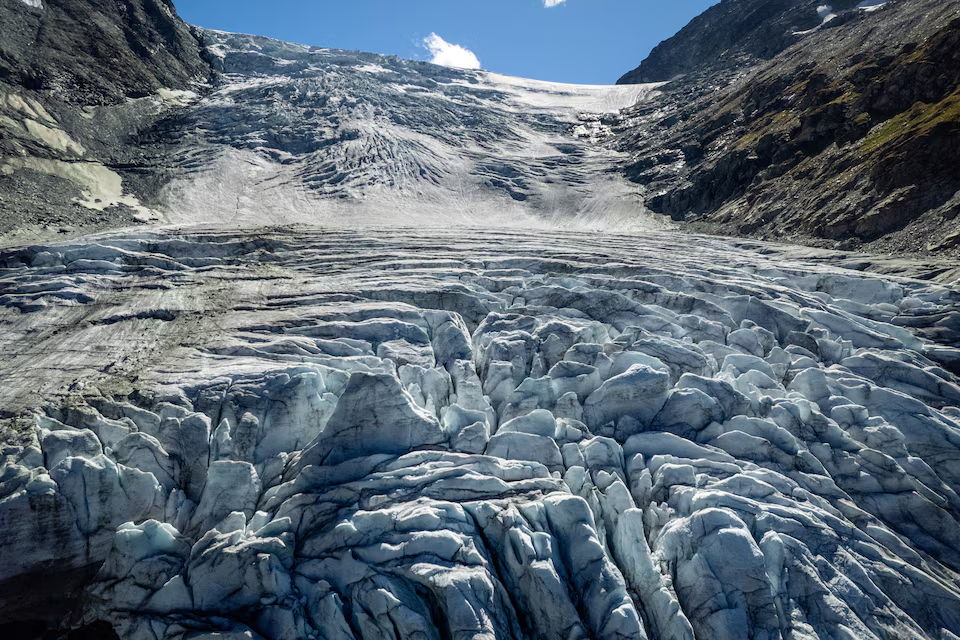
Switzerland’s glaciers have undergone severe melting over the past 12 months, recording the fourth-largest loss of ice volume on record, monitoring body GLAMOS reported on Wednesday.
According to the annual assessment by GLAMOS and the Swiss Cryosphere Observation Commission, low snowfall during winter—particularly in northeastern parts of the Alps—followed by extreme heat in June caused glaciers to lose about 3% of their total ice mass.
“That is really a lot,” said Matthias Huss, GLAMOS director, whose report covers the hydrological year from October to September.
Although the pace of melting was less dramatic than in 2022 and 2023, when glaciers shrank by 5.9% and 4.4% respectively, the long-term trend is clear.
Speaking to Reuters during a visit to the Rhône Glacier in the canton of Valais, Huss said this has been the worst decade for Swiss ice loss, with a quarter of the glaciers’ volume disappearing since 2015.
Once Europe’s largest during the Ice Age, the Rhône Glacier has thinned by an average of 1.5 meters this year alone, continuing its rapid retreat.
Between 2016 and 2022, Switzerland lost around 100 glaciers altogether, GLAMOS noted, warning that most of the country’s remaining glaciers could vanish by the end of the century.
“Unfortunately, there’s not much we can do to save the glaciers,” Huss said. “Even if the climate stabilized today, they would keep retreating.”
He added, however, that if global carbon dioxide emissions were cut to net zero within the next 30 years, about 200 higher-altitude glaciers could still be preserved.
This year, glaciers below 3,000 meters were hit especially hard. The Silvretta Glacier in northeastern Switzerland, once considered relatively stable, lost significant ice after the region recorded its lowest snowfall since measurements began nearly a century ago.
Huss also warned that shrinking glaciers are destabilizing mountain landscapes, triggering landslides and ice avalanches—such as the catastrophic glacier collapse in May that devastated the village of Blatten in Valais.