News
Spain’s Summer Wildfires Intensify Calls for Better Forest Management

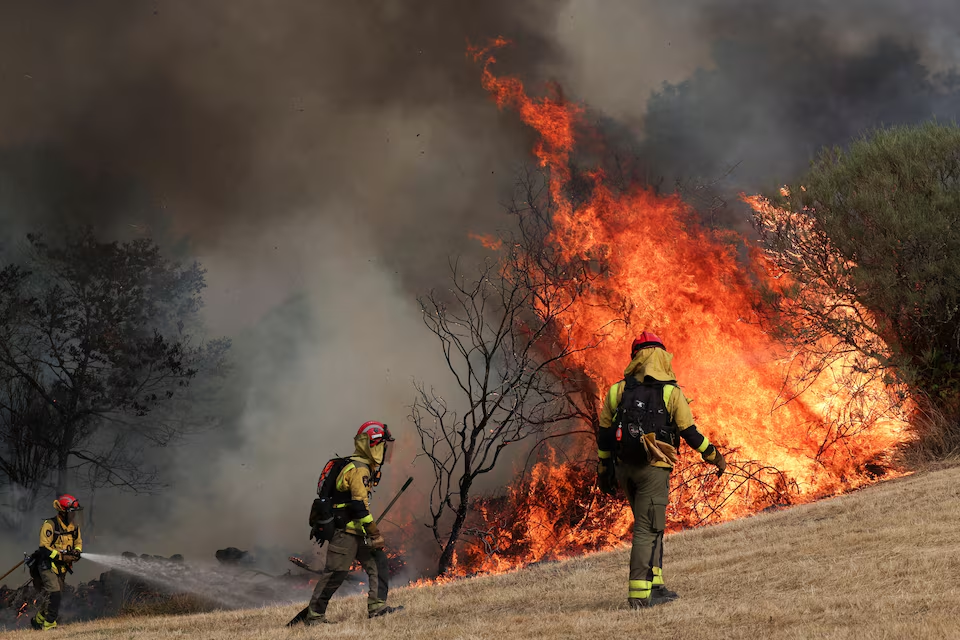
Firefighters work to battle a wildfire in the village of Parafita, Galicia region, Spain, August 12, 2025. REUTERS
Javier Fernández Pérez recalls how, in his village, residents once burned brush in winter to prevent the kind of devastating wildfires that scorched Spain’s northwestern Galicia region last summer.
With hotter, drier conditions fueling ever-larger blazes, experts and locals are pressing for urgent fire-prevention measures, improved forest management, and new incentives to curb the risk of future disasters.
Southern Galicia was the epicenter of Spain’s worst fire season in three decades. In August, amid record heat, wildfires killed four people, swept into towns and cities, and consumed 330,000 hectares of land—an area twice the size of London.
“If nothing is done, it will happen again in about six years,” said Fernández Pérez, a 72-year-old retired waiter and baker. “Once all that vegetation goes up, there’s no stopping it.”
A wildfire just weeks earlier had destroyed 19,000 hectares around his village of Parafita. “There was no way to control it,” he said. “Not with helicopters, not with planes, not with anything.”
A Warning for Europe
Forestry experts and political leaders argue that two decades of underinvestment in management and prevention worsened the scale of the fires.
Víctor Resco, professor of forestry engineering at the University of Lleida, said Spain’s experience is a test case for Europe. “What we’re seeing here is a preview of Europe’s future,” he said. “In 20 or 30 years, as central and northern Europe heat up, it will be too late to change course.”
Prime Minister Pedro Sánchez admitted in August that prevention had been “clearly inadequate” and pledged to do “whatever it takes” to avoid another catastrophe of this scale.
Expanding Forests, Weakened Stewardship
Spain has 18.6 million hectares of forest—third in Europe after Sweden and Finland—and its woodlands are expanding at 2.2% annually, well above the European average. That growth, coupled with depopulation in rural areas, has left vast tracts unmanaged.
Traditional preventive practices, such as controlled burns, have been complicated by regulation. Meanwhile, two-thirds of Spanish forests are privately owned, mostly by individuals with little experience in forestry. Fewer than a quarter of forest areas have long-term sustainable management plans, according to the Environment Ministry.
“In some cases, two generations of owners have never even set foot on their land,” said Environment Secretary Hugo Morán.
Patricia Gómez Agrela of COSE, an association of private forest owners, argued that tax breaks are needed to recognize forests’ roles in carbon capture, water management, and wildlife habitat. She also called for incentives to make woodlands more economically viable through the use of timber, biomass, cork, seeds, mushrooms, and fruits.
“There’s a European biodiversity strategy that discourages intervention in certain areas,” she said. “But when too much vegetation builds up, the fire risk rises—and then you lose the very biodiversity you meant to protect. We need balance.”
The Funding Gap
The Spanish Association of Forest Engineers estimates that every euro spent on prevention saves €100 in firefighting costs. Greenpeace and others want at least €1 billion annually devoted to prevention.
Yet between 2009—at the height of the financial crisis—and 2022, national and regional governments cut fire-prevention spending by 52% and forestry spending by 22%, even as firefighting budgets remained flat, Environment Ministry data show. Investments have begun to recover since 2017–2018, but gaps remain.
Spain also dedicated only a small share of post-pandemic EU recovery funds to fire prevention, even though it faces high risk. According to the European Court of Auditors, Spain spent €221 million of EU funds on prevention and rapid response—about one-third the amount allocated by Portugal and a quarter of Greece’s spending.
Meanwhile, Sánchez’s minority Socialist-led government is under pressure from NATO allies and U.S. President Donald Trump to boost Spain’s defense budget by nearly €50 billion a year. At the same time, it faces mounting bills for recovery from devastating floods and fires in Valencia.
“Climate adaptation and mitigation must be understood as defense,” Morán argued. “It makes no sense to increase military budgets while ignoring the greatest threat to our citizens’ security today.”
($1 = €0.8516)