News
Nobel Peace Prize 2025: How Is the Winner Chosen?

The winner of the 2025 Nobel Peace Prize will be announced on October 10. Here’s a closer look at how the world’s most prestigious peace award is decided:
Who decides?
The prize is awarded by the Norwegian Nobel Committee, a five-member body appointed by Norway’s parliament. Members are often retired politicians, though not always. The current committee is chaired by the head of PEN International’s Norwegian branch, a free-speech advocacy group, while another member is an academic.
Appointments reflect the political balance in Norway’s parliament, with each party nominating representatives.
Who can win?
In theory, anyone meeting the criteria set out in Alfred Nobel’s 1895 will. The will specifies that the award should go to the person or group that has done “the most or the best work for fraternity between nations, for the abolition or reduction of standing armies, and for the holding and promotion of peace congresses.”
In practice, the definition is broader. According to Kristian Berg Harpviken, secretary to the committee who prepares its work (but does not vote), decisions are made “in the context of the present moment.”
“They look at the world as it is—at global trends, key concerns, and the most promising processes,” he told Reuters. “And by processes, we could mean anything from a specific peace negotiation to a new type of international agreement, either under development or recently adopted.”
Who can nominate?
Thousands of people worldwide are eligible to submit nominations, including government officials, members of parliament, heads of state, university professors in history, law, philosophy and social sciences, and former Nobel Peace Prize laureates.
This year there are 338 candidates. The full list is sealed for 50 years, though nominators are free to disclose their choices publicly.
How is the decision made?
Nominations close on January 31. Committee members may also submit proposals before their first meeting in February.
From there, the committee debates, compiles a shortlist, and commissions evaluations from permanent advisers and other experts. They meet roughly once a month, with the final decision typically made in August or September.
The committee strives for consensus, but if necessary, decisions are made by majority vote. The last time a member resigned in protest was in 1994, when Yasser Arafat shared the prize with Israel’s Shimon Peres and Yitzhak Rabin.
Who’s in the running?
Although the official list remains secret, some names have surfaced. These include the International Criminal Court, NATO, jailed Hong Kong activist Chow Hang-tung, and Canadian human rights lawyer Irwin Cotler.
Leaders in Cambodia, Israel, and Pakistan have said they nominated former U.S. President Donald Trump, but their proposals were submitted after the January deadline and are therefore invalid for 2025.
Could Trump still win?
Experts say only if he changes course dramatically. For now, they argue, his policies undermine the international order the Nobel Committee seeks to uphold.
Instead, the prize could go to a humanitarian group, journalists, or a UN body—or the committee could deliver a surprise.
Last year, the award went to Nihon Hidankyo, an organization representing Japanese survivors of the atomic bombings. Nuclear disarmament has long been a central theme for the committee.
What does the winner receive?
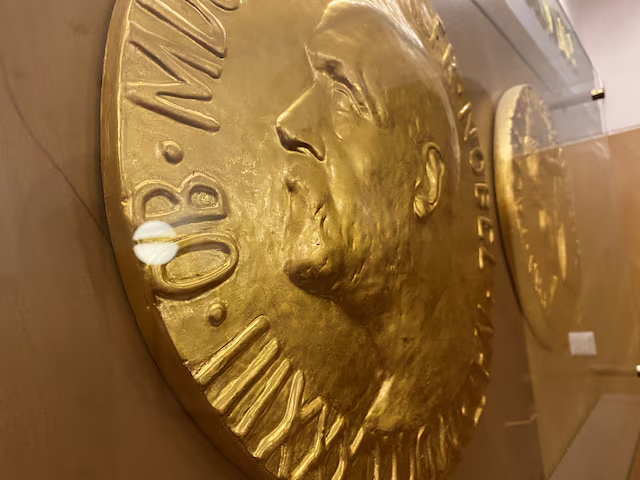
The laureate receives a gold medal, a diploma, 11 million Swedish kronor ($11.9 million), and instant worldwide recognition.
When are the announcement and ceremony?
The winner will be revealed on Friday, October 10 at 11:00 CET (09:00 GMT) at the Norwegian Nobel Institute in Oslo by committee chair Jørgen Watne Frydnes.
The award ceremony will take place on December 10, the anniversary of Alfred Nobel’s death, at Oslo City Hall.
(1 USD = 9.2502 SEK)