World News
US Supreme Court Strikes Down Donald Trump Global Tariffs, Reasserts Congress’ Control Over Trade Policy
In a landmark ruling that reshapes the boundaries of presidential power over trade, the US Supreme Court has struck down sweeping global tariffs imposed during the presidency of Donald Trump.

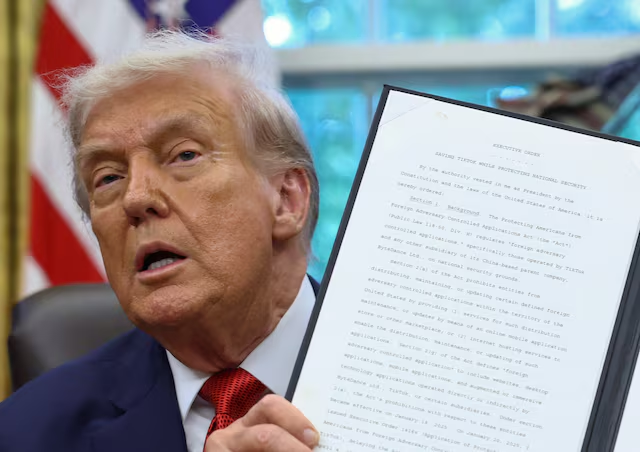
In a landmark ruling that reshapes the boundaries of presidential power over trade, the US Supreme Court has struck down sweeping global tariffs imposed during the presidency of Donald Trump.
The Court ruled that the administration overstepped its authority by using emergency economic powers to justify across-the-board import duties on multiple countries. The decision marks a major turning point in the long-running debate over executive control of trade policy.
Why the Court Intervened
At the heart of the case was the use of the International Emergency Economic Powers Act (IEEPA). The Trump administration had relied on this law to impose tariffs, arguing that trade imbalances and economic pressures constituted a national emergency.
However, the Court clarified that IEEPA was designed to address extraordinary external threats, not to restructure global trade systems or impose broad-based taxes on imports.
Writing for the 6–3 majority, Chief Justice John Roberts stated that while the President may regulate certain foreign economic transactions under IEEPA, the power to impose tariffs—effectively taxes on imports—rests constitutionally with Congress.
The Court emphasized that allowing emergency powers to be used for tariff imposition would blur the separation of powers and transfer Congress’ authority over taxation to the executive branch.
A Divided Bench, But a Clear Message
Justices Sonia Sotomayor, Elena Kagan, and Ketanji Brown Jackson joined the majority opinion. They stressed that the case could be resolved purely through statutory interpretation, without expanding executive authority under emergency laws.
Justice Amy Coney Barrett agreed with the outcome but wrote separately, underscoring that tariffs are legally distinct from regulating economic transactions. In her view, allowing tariffs under IEEPA would effectively let any President impose sweeping duties simply by declaring an emergency — a power Congress never intended to grant.
In dissent, Justice Brett Kavanaugh, joined by Samuel Alito and Clarence Thomas, argued that the President acted within his historical authority over imports during foreign economic crises. The dissent warned that the ruling could create uncertainty for trade negotiations and complicate the refund of previously collected duties.
Impact on Global Trade — And India
The tariffs had covered a wide range of imports, from electronics and machinery to everyday consumer goods. Industry groups, importers, and several US states had challenged the measures, calling them taxation without Congressional approval.
The ruling carries immediate relevance for India. During recent negotiations with Washington, India had faced reciprocal tariffs of up to 18 percent. With the legal basis for those duties now invalidated, Indian exporters may see reduced uncertainty and improved market access.
Trade experts believe the judgment could reset ongoing discussions between the two countries and bring greater predictability to supply chains.
A Broader Constitutional Signal
Beyond trade policy, the decision sends a strong constitutional message: emergency economic powers cannot be stretched into permanent policymaking tools.
By reaffirming that tariff authority belongs primarily to Congress, the Court has drawn a clear line between emergency action and long-term economic strategy.
For businesses, global markets, and trading partners alike, the ruling provides clarity — and underscores that even in times of economic strain, the balance of power in Washington remains firmly defined by the Constitution.
Read Also : BJP Will Not Support Congress on Revenue Deficit Grant Issue: Jai Ram Thakur