World News
EAM Jaishankar Conveys India’s Condolences on Former Bangladesh PM Khaleda Zia’s Death
External Affairs Minister S. Jaishankar conveyed India’s condolences on the death of former Bangladesh Prime Minister Khaleda Zia and will represent India at her funeral as Bangladesh observes state mourning.

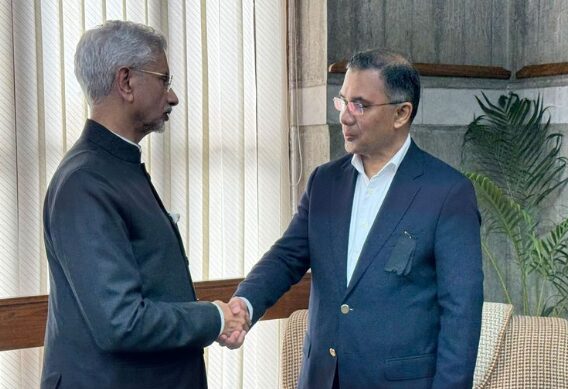
External Affairs Minister S. Jaishankar has conveyed the condolences of the people and Government of India on the death of former Bangladesh Prime Minister Begum Khaleda Zia, Bangladesh High Commissioner to India Riaz Hamidullah said on Wednesday.
In a post on X, Hamidullah said that during his visit to Dhaka, Jaishankar expressed India’s sympathy as Bangladesh mourns the passing of its former prime minister. He also acknowledged Khaleda Zia’s contribution to democracy and expressed optimism about strengthening bilateral ties following Bangladesh’s democratic transition and the upcoming elections scheduled for February 2026.
“HE @DrSJaishankar, Hon. External Affairs Minister, in Dhaka, conveys condolences of the people & Government of India as Bangladesh mourns the passing of former Prime Minister Begum Khaleda Zia, recognised her contribution to democracy and expressed optimism to strengthen ties following democratic transition,” Hamidullah wrote.
As tributes poured in from across the world, Khaleda Zia’s body was brought to her Gulshan residence, Firoza, on Wednesday, where family members and close relatives paid their last respects ahead of her Namaz-e-Janaza.
Bangladesh’s Chief Adviser Muhammad Yunus confirmed the arrival of her body at the residence, saying family members gathered for final prayers in an atmosphere of solemn grief. BNP Acting Chairman Tarique Rahman was present and was seen quietly offering prayers beside his mother.
The funeral prayer for the former prime minister is scheduled to be held at 2 pm on Manik Mia Avenue, at the South Plaza of the National Parliament Building. Large crowds gathered at the venue, with reports suggesting millions of mourners participating.
Chief Adviser Muhammad Yunus and other senior dignitaries are expected to attend the funeral. Following the prayers, Khaleda Zia will be laid to rest beside her husband, former president Ziaur Rahman, at his mausoleum in Sher-e-Bangla Nagar.
India has confirmed official participation in the funeral. The Ministry of External Affairs said EAM Jaishankar would represent India at the last rites.
“The External Affairs Minister, Dr. S. Jaishankar, will represent the Government and people of India at the funeral of Begum Khaleda Zia, former Prime Minister of Bangladesh and Chairperson of the Bangladesh Nationalist Party,” the MEA said in a statement.
Senior representatives from several South Asian countries, including Pakistan, Nepal, Bhutan, Sri Lanka and the Maldives, are also expected to attend.
Bangladesh has declared a public holiday and is observing a three-day period of state mourning. Khaleda Zia, Bangladesh’s first woman prime minister, died on Tuesday at the age of 80 after a prolonged illness. She served three terms as prime minister and played a key role in restoring democracy after years of military rule.
BNP leaders said the funeral prayer will be led by the khatib of the Baitul Mukarram National Mosque. BNP Secretary General Mirza Fakhrul Islam Alamgir appealed to mourners to maintain discipline and preserve the dignity of the ceremony.
Security has been heightened across Dhaka, with over 10,000 police and Armed Police Battalion personnel deployed, along with army units at key locations. Vehicular movement along several routes remains restricted.
Prime Minister Narendra Modi on Tuesday expressed deep sorrow over Khaleda Zia’s death, recalling his meeting with her in Dhaka in 2015 and extending condolences to her family and the people of Bangladesh.
Condolences also poured in from world leaders and international organisations, including the United Nations, European Union, United States, China, Russia, Pakistan, Nepal, Malaysia and several other countries, acknowledging Khaleda Zia’s contribution to Bangladesh’s political and democratic development.