News
Explainer: Nuclear Testing — Why It Stopped, Why It Might Resume, and Who Has the Bombs

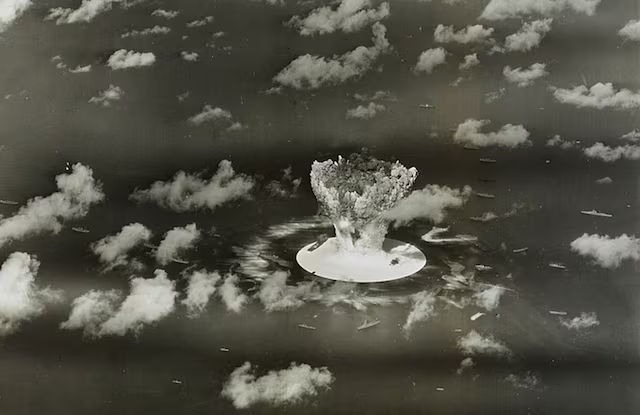
U.S. President Donald Trump on Thursday ordered the U.S. military to immediately resume nuclear weapons testing after a 33-year hiatus — an announcement made just minutes before his meeting with Chinese President Xi Jinping.
That raises key questions: How many nuclear tests have been conducted? Why did they stop? And why would any country start again?
The Nuclear Age
The nuclear age began in July 1945, when the United States detonated a 20-kiloton atomic bomb in Alamogordo, New Mexico. Just weeks later, the U.S. dropped atomic bombs on Hiroshima and Nagasaki, forcing Japan’s surrender and ending World War II.
Only four years later, in August 1949, the Soviet Union stunned the West by detonating its first nuclear bomb.
According to the United Nations, between 1945 and the signing of the Comprehensive Nuclear-Test-Ban Treaty (CTBT) in 1996, over 2,000 nuclear tests were carried out — 1,032 by the United States and 715 by the Soviet Union.
The United Kingdom conducted 45 tests, France 210, and China 45.
Since the CTBT, only 10 tests have taken place: India (2 in 1998), Pakistan (2 in 1998), and North Korea (six tests between 2006 and 2017).
The U.S. last tested in 1992, the Soviet Union in 1990, and both China and France in 1996.
While Russia has conducted recent nuclear drills — including testing a nuclear-powered cruise missile and a nuclear-powered torpedo — it has not tested an actual nuclear warhead.
Why Did Nuclear Testing Stop?
Mounting concerns about the health and environmental impacts of above-ground, underground, and underwater nuclear explosions eventually brought testing to a halt.
Tests in the Pacific Islands and across Kazakhstan and the Arctic left deep scars — from radiation poisoning to widespread environmental destruction. Activists say millions of people in these regions continue to suffer long-term health effects and displacement from contaminated land.
Beyond the human toll, ending nuclear testing was also seen as a way to ease Cold War tensions between Washington and Moscow.
The CTBT, adopted in 1996, bans all nuclear explosions everywhere and by everyone. Russia signed the treaty in 1996 and ratified it in 2000. The United States signed it in 1996 but has never ratified it.
In 2023, Russian President Vladimir Putin formally withdrew Russia’s ratification, bringing Moscow’s legal stance in line with Washington’s.
Why Would Countries Resume Testing?
The reasons are both technical and political — to gather data, or to send a signal.
Testing can confirm whether new weapons designs work and whether older warheads remain reliable.
In 2020, The Washington Post reported that the Trump administration had discussed the possibility of conducting a nuclear test to demonstrate U.S. power.
But such a move would be widely seen — especially in Russia and China — as a deliberate display of strength, potentially sparking a new arms race.
Putin has repeatedly warned that if the U.S. resumes testing, Russia will do the same, insisting that a global nuclear competition is already underway.
Who Has Nuclear Weapons?
Exact numbers are closely guarded secrets, but the Federation of American Scientists (FAS) estimates that:
Russia holds around 5,459 warheads
The United States about 5,177
(both figures include deployed, stored, and retired warheads)
The Arms Control Association puts the totals at roughly 5,580 for Russia and 5,225 for the U.S.
Globally, nuclear stockpiles peaked at more than 70,000 warheads in 1986, the vast majority in the U.S. and the Soviet Union. That number has since dropped to about 12,000, though most remain in the hands of Washington and Moscow.
According to FAS estimates:
China – 600 warheads
France – 290
United Kingdom – 225
India – 180
Pakistan – 170
Israel – 90
North Korea – around 50
Meanwhile, Russia, the United States, and China are all investing heavily in modernizing their nuclear forces — a reminder that, despite decades of treaties and reductions, the nuclear age is far from over.