News
Angola Returns to Capital Markets With Eurobond Sale as Borrowing Conditions Improve

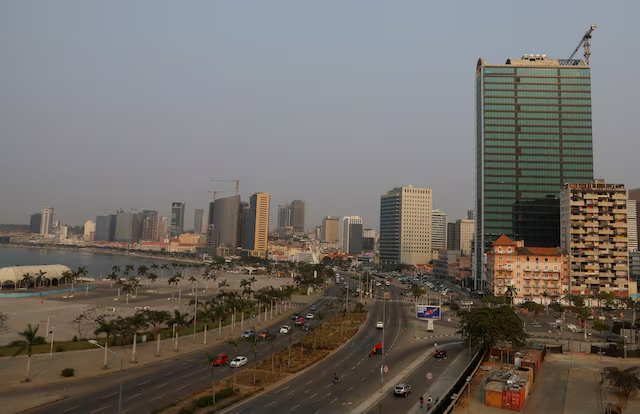
Angola is planning to raise $1.5 billion in its return to the international capital markets, the Finance Ministry said on Tuesday — marking its first global bond issue since 2022 and making it the latest African sovereign to take advantage of the most favorable borrowing conditions in six years.
According to a filing released on Tuesday, the southern African nation is offering five-year and ten-year U.S. dollar bonds maturing in January 2031 and October 2035, respectively, with initial pricing indications around 9.75% and 10.50%.
The bond sale forms part of Angola’s 2025 financing plan, which aims to raise about $6 billion through debt instruments to meet total funding needs of $14.9 billion, the ministry report said.
The transaction comes at a critical time for the country. Angola faces an $864 million bond repayment due in November and has borrowed $1 billion through a total return swap with J.P. Morgan, which expires in December.
Dorivaldo Teixeira, head of the Debt Management Office at the Finance Ministry, told Reuters on Tuesday that the government has not yet decided whether it will extend the total return swap, which currently carries a 9% interest rate.
Yields on Angola’s 2032 international bonds rose 14 basis points on Tuesday to 9.86%, though they remain close to their lowest level since February 2023.
Citi, Deutsche Bank, J.P. Morgan, and Standard Chartered are joint lead managers for the sale.
Investor Appetite for African Debt Rising
Angola’s return highlights a broader revival of interest in African sovereign bonds. The premium investors demand to hold African debt over U.S. Treasuries — tracked by J.P. Morgan’s Africa NEXGEM Index — has fallen to its lowest level since the benchmark’s launch in 2019.
“The easing cycle will further fuel the hunt for yield, especially in a world flush with liquidity,” said Dan Wood, portfolio manager at William Blair Investment Management.
Bond issuance from smaller and riskier “frontier markets” has been scarce in recent years.
“So far, issuance has remained quite limited, which has supported valuations,” noted Aurélie Martin, emerging-market fixed income analyst at Ninety One.
Recent credit upgrades and fiscal reform progress have added momentum. Fitch and Moody’s have both raised Nigeria’s sovereign ratings by one notch, while S&P Global has removed Ghana from default status and reaffirmed a positive outlook for South Africa.
Which African Nations Could Issue Next?
The Democratic Republic of the Congo has received cabinet approval for its first-ever international bond, expected to raise about $1.5 billion, potentially before mid-2026. Nigeria has indicated it could issue up to $2.3 billion in Eurobonds by the end of this year.
Samir Gadio, head of Africa strategy at Standard Chartered Bank, expects South Africa to return to the market after its Medium-Term Budget Policy Statement in November.
More broadly, emerging-market debt sales are on track for a record year.
However, analysts warn that the outlook could darken if the global economy slows.
“In a scenario where global inflation resurges and/or trade tensions sharply weaken growth, we could see renewed pressure on this asset class,” said Can Nazlı, portfolio manager at Neuberger Berman.
Falling commodity prices or widening fiscal deficits could also test investor appetite for African debt.
“African assets still carry elevated risks,” said Razia Khan, chief economist for Africa and the Middle East at Standard Chartered. “The rally has lasted longer than many expected — but it’s not without its vulnerabilities.”