News
Trump Administration Pushes Industry Deals Ahead of Midterm Elections

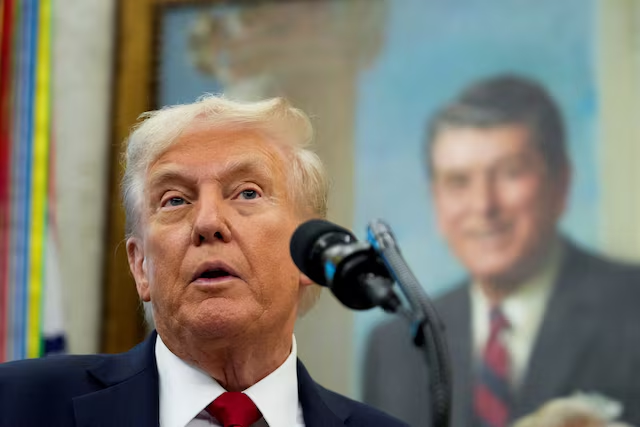
The Trump administration is ramping up negotiations across dozens of industries as it seeks high-profile wins ahead of the 2026 midterm elections.
Eli Lilly (LLY.N) has been asked to boost insulin production; Pfizer (PFE.N) has opened a new line to expand output of its blockbuster cancer drug Ibrance and cholesterol pill Lipitor; and London-based AstraZeneca (AZN.L) has begun exploring a potential new U.S. headquarters, according to two people familiar with the matter.
Pharmaceutical executives are receiving near-daily calls from senior White House staff—including Chief of Staff Susi Wiles—as well as top officials at the Department of Health and Human Services (HHS) and the Commerce Department, the sources said.
But drugmakers are only part of the push.
According to more than half a dozen people familiar with the talks, the administration is working on deals across 30-plus industries, many involving companies deemed critical to national or economic security. In some cases, Washington is offering tariff relief, revenue guarantees, or even equity stakes in struggling firms in exchange for price cuts, domestic investment, or other commitments. The accelerated dealmaking is widely seen as designed to deliver political wins for President Donald Trump ahead of November 2026.
On Tuesday, Trump announced an agreement with Pfizer CEO Albert Bourla to cut drug prices in exchange for relief from planned tariffs on imported medicines. “America is no longer going to subsidize the rest of the world’s healthcare,” Trump declared at an Oval Office event.
The presentation of these deals matters as much as the deals themselves, two sources noted. White House officials insist that major announcements come directly from the president. Eli Lilly learned that firsthand in September, when the administration complained after the company unveiled two new manufacturing sites without Trump.
Lilly said it was unaware of such discussions, with a spokesperson adding: “As an American company, Lilly remains committed to expanding manufacturing capacity in the U.S.” Pfizer and AstraZeneca declined to comment, and the White House would not discuss specifics.
White House spokesperson Kush Desai described the broader effort as a “whole-of-government approach to bargaining,” aimed at protecting U.S. national and economic security. Six people familiar with the initiative said the strategy is designed to leverage government powers to bring manufacturing back to the United States, reduce dependence on China, strengthen supply chains for critical goods, and generate revenue for the Treasury.
Industries affected include semiconductors, artificial intelligence, quantum computing, critical minerals, shipbuilding, energy, batteries, pharmaceuticals, and freight.
This represents one of the most extensive interventions in the U.S. economy in decades, challenging the laissez-faire traditions long associated with American capitalism. “It’s remarkable that a Republican administration is taking us further from traditional capitalism than any Democratic administration has,” said John Coffee, a corporate law professor at Columbia University.
A $250 Billion Financing Engine
To bankroll the strategy, the administration is leaning on the little-known U.S. International Development Finance Corporation (DFC), established under the 2018 BUILD Act to fund overseas projects. Under a proposal sent to Congress in June, its funding authority would jump from $60 billion to $250 billion and include a new equity fund for infrastructure, energy, minerals, and supply chains—anything deemed vital to U.S. national or economic security.
The plan awaits congressional approval and the confirmation of Ben Black, son of Apollo Global Management co-founder Leon Black, to lead the agency. The DFC said it aims to mobilize private investment for projects that advance U.S. strategic interests, including reducing reliance on Chinese-controlled minerals.
In parallel, Commerce Secretary Howard Lutnick is preparing to launch a new U.S. Investment Accelerator, seeded with $550 billion that Japan has pledged under a trade agreement. Both programs are expected to replace the sovereign wealth fund Trump once floated but later dropped.
Agencies as Dealmakers
At HHS, former healthcare investor Chris Klomp and ex-policy adviser John Brooks are steering pharma talks, while Wiles is directly involved in the biggest negotiations. Lutnick, a former bond trader and head of Cantor Fitzgerald, has become Trump’s chief dealmaker, overseeing major moves such as Commerce’s “golden share” in U.S. Steel following Nippon Steel’s $14.9 billion acquisition.
Other Wall Street veterans have also joined, including banker Michael Grimes and M&A lawyer David Shapiro, to lead negotiations in key sectors. JPMorgan has been enlisted to execute government-backed deals, such as its arrangement with rare earths miner MP Materials.
The government’s approach has split industry reaction. Some companies welcome the chance to tap federal money and align with policy goals, while others worry about being forced to cede equity stakes or make politically driven decisions. “People are nervous about walking into a meeting about loans or grants and being told: ‘We want 10% of your company,’” said one mining executive.
Critics argue the push amounts to state capitalism. “It’s ironic that free-market advocates are now embracing the very state-led model they once criticized,” said Aldo Musacchio, an expert on state capitalism.
Still, officials insist equity stakes are a practical tool to reduce risks in strategic sectors, safeguard taxpayer value, and restore U.S. jobs. The MP Materials deal—where the Pentagon took a 15% stake, guaranteed a floor price for rare earth purchases, and secured Apple as a long-term buyer—is seen as a template for future arrangements.
Overall, the strategy represents a fundamental shift: the U.S. government stepping directly into the marketplace, not only as a regulator but as a shareholder, financier, and negotiator.