News
‘Where Am I Safe?’: UK Court Ruling Leaves Trans Lives in Turmoil

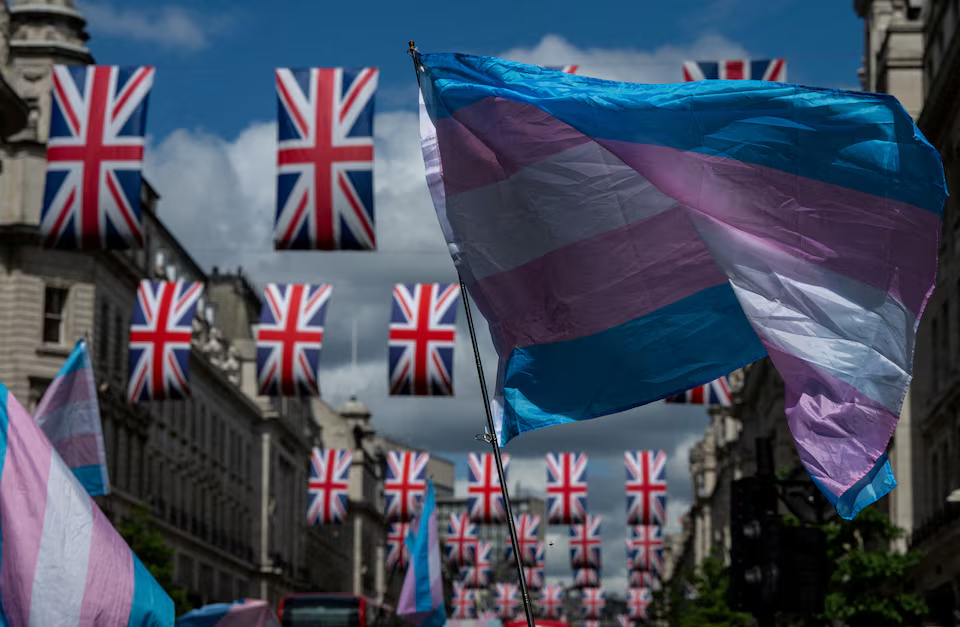
For years, Nat Rae felt secure living openly as a transgender man after coming out in his late twenties. But that sense of safety has been shaken by a recent UK Supreme Court ruling redefining the legal meaning of sex.
Rae, a PhD student and science communicator who grew up in a small Scottish town before moving to London, says he now constantly weighs risks and asks himself where he can live safely—or where he cannot.
In April, the court confirmed that under equality law, the word “sex” refers to biological sex. In practice, this means a transgender woman is legally regarded as male, and a transgender man as female.
The Equality and Human Rights Commission (EHRC) has said in interim guidance that the ruling requires trans people to be excluded from services and facilities designed for their gender identity—from toilets and hospital wards to shelters.
“It’s almost like harassing trans people has been made legal,” Rae, 33, told Reuters during an interview at Gay’s the Word, Britain’s oldest LGBT+ bookstore. He said he is now “hyper-aware” of being watched. “I have to pay attention to things I never had to before—where I go, where I’m safe.”
A Polarizing Debate
Rae, who only recently began medical transition, often uses women’s bathrooms because he believes most people still perceive him as female. Since the ruling, he has been told several times not to use certain toilets, called “disgusting” when he did, and once confronted with: “Do you realize there are children here?”
Transgender rights have become a political flashpoint in Britain and beyond. In the United States, former President Donald Trump rolled back protections for transgender people through multiple executive orders. Critics argue that conservative groups have weaponized identity politics to target minorities, while others contend that supporting transgender inclusion undermines the rights and safety of biological women in spaces such as hospitals, prisons, and domestic violence shelters.
The UK government has said the judgment provides clarity around gender policy. But for Rae and many others, it has reinforced a sense of exclusion.
A report by advocacy group TransActual, released in August, found that since the ruling some trans people have considered leaving the country, concealing their identity, avoiding hospitals and public spaces, feeling isolated at work, or withdrawing from social life altogether.
When asked about these concerns, a government spokesperson said laws remain in place to protect trans people from discrimination and harassment.
Young Trans People ‘Terrified’
The EHRC submitted updated draft guidance to the government in early September, which Parliament is expected to review by year’s end. Kean Walker, strategy director at TransActual, said the interim guidance has already had a “serious impact” and argued that the EHRC could have chosen a less “extreme” interpretation of the court’s decision.
Some institutions have already adjusted their rules: the Football Association has banned transgender women from competing in women’s football in England, while British Transport Police now require searches of detainees to be conducted according to biological sex.
An EHRC spokesperson said all actions since the ruling are in line with the law, and that the draft guidance shared with government is both “legally accurate and clear.”
For Rae, the danger is not just legal but social: that the ruling encourages people to question, police, or threaten those who live openly in their gender identity.
“I’ve spoken to so many young trans people, and they’re all terrified,” Rae said. “A lot are now asking: can I live the life I want, and be who I really am?”