News
Netanyahu to Meet Trump at White House as Gaza Peace Push Gains Urgency

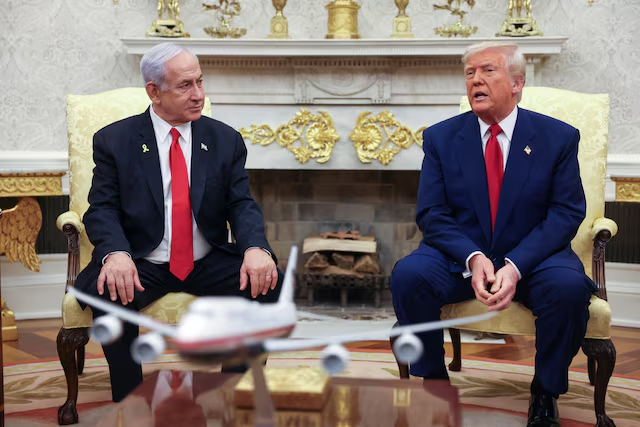
Donald Trump will host Israeli Prime Minister Benjamin Netanyahu at the White House on Monday, seeking to advance a long-stalled Gaza peace proposal even as several Western nations have recognized Palestinian statehood over U.S. and Israeli objections.
This marks Netanyahu’s fourth trip to Washington since Trump took office in January. The right-wing Israeli leader aims to bolster his country’s most crucial alliance at a time when, nearly two years into the war against Hamas in Gaza, Israel faces mounting international isolation.
Unlike the chilly reception he received at the U.N. General Assembly on Friday—where numerous delegates staged walkouts—Netanyahu is expected to be warmly welcomed in Washington.
In recent remarks, Netanyahu blasted Britain, France, Canada, Australia, and others for what he called the “shameful decision” to recognize Palestinian statehood, a diplomatic sea change among some of Washington’s closest allies. Supporters of recognition said the move was necessary to preserve the possibility of a two-state solution and help end the war.
Trump, who condemned the recognition as “a reward for Hamas,” told Reuters on Sunday that he hopes Netanyahu will agree to a framework that could both end the war in Gaza and secure the release of remaining hostages held by Hamas.
Using Netanyahu’s nickname, Trump said in a phone interview, “We’re getting very good feedback because Bibi wants this deal, too. Everyone wants this deal.” He credited leaders from Saudi Arabia, Qatar, the UAE, Jordan, and Egypt for their support, adding that the aim is to establish broader Middle East peace beyond Gaza.
“This is about peace in the Middle East,” Trump said. “Gaza is part of it, but the goal is much larger.”
Asked whether an agreement was imminent, a senior Israeli official replied, “It’s too early to say,” noting Netanyahu will present Israel’s response during Monday’s meeting. Netanyahu faces growing pressure from hostage families and a war-weary Israeli public, as reflected in opinion polls.
Last week, a 21-point peace plan was circulated to several Arab and Muslim countries at the U.N., calling for the release of all hostages, a halt to further Israeli strikes on Qatar, and renewed talks on “peaceful coexistence” between Israelis and Palestinians. Tensions flared earlier this month when Israeli airstrikes in Doha targeted Hamas leaders, angering Qatar and drawing Trump’s criticism.
Past U.S.-backed ceasefire efforts collapsed over deep divisions between Israel and Hamas. Netanyahu has vowed to fight until Hamas is fully eliminated.
The Gaza war dominated last week’s U.N. gathering, where Israel came under sharp criticism. Netanyahu fired back, accusing world leaders who recognized Palestinian independence of sending the message that “murdering Jews pays.”
Israel’s most right-wing government in history has rejected Palestinian statehood outright, citing Hamas’s October 7, 2023, attack that killed about 1,200 people in Israel, according to Israeli figures. Gaza health officials say more than 65,000 Palestinians have been killed in Israel’s offensive, leaving much of the enclave in ruins and its population facing hunger and deepening humanitarian catastrophe.
The International Criminal Court has issued a warrant against Netanyahu for alleged war crimes, which Israel rejects, insisting the court has no jurisdiction.
Though Trump and Netanyahu have generally enjoyed close relations and Washington remains Israel’s key arms supplier, Monday’s talks could expose rifts. Some of Netanyahu’s hardline ministers have urged him to counter growing recognition of Palestine by formally extending Israeli sovereignty over all or parts of the occupied West Bank.
Trump, however, said last Thursday he would not permit Israel to annex the territory, which Palestinians seek—alongside Gaza and East Jerusalem—as part of their future state.
Analysts warn that any West Bank annexation could unravel the historic Abraham Accords, a landmark achievement of Trump’s first term that normalized relations between Israel and several Arab states.