News
Seoul Says U.S. Agrees South Korea Is Not a Currency Manipulator

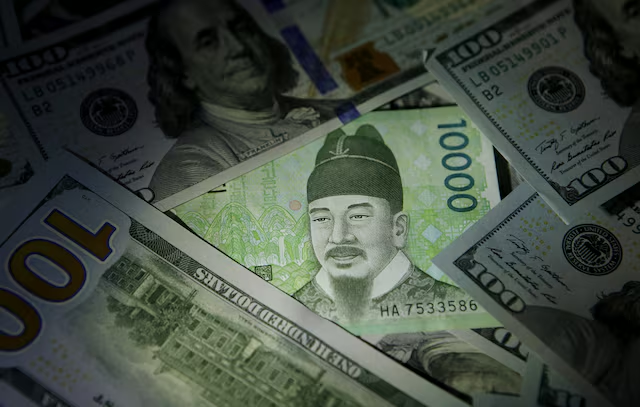
South Korean President Lee Jae-myung’s spokesperson said Sunday that Washington agrees Seoul is not manipulating its currency for trade advantage.
At a press conference, Kang Yoo-jung stated that both allies concurred South Korea does not fall under the category of “currency manipulators” identified in the U.S. Treasury Department’s semiannual reports.
Officials at the U.S. Embassy in Seoul were not immediately available for comment outside working hours.
The Biden administration had placed South Korea on its currency monitoring list in November, citing the country’s large current account surplus and its significant trade surplus with the United States. The Trump administration had similarly added Seoul to the list in June.
Under a 2015 U.S. law, Washington can take “remedial action” against countries that fail to correct what it deems “undervalued exchange rates and trade surpluses” with the United States.
South Korean officials stressed that the latest understanding with Washington is unrelated to ongoing bilateral talks over tariffs on Korean goods imposed under former President Donald Trump, which also included discussions on foreign exchange.
Finance Minister Koo Yoon-chul said Saturday that during President Lee’s meeting in New York with U.S. Treasury Secretary Scott Bassent on Wednesday, Lee explained that South Korea requires access to foreign exchange markets to fulfill its $350 billion investment commitments tied to the tariff negotiations.
According to Koo, Bassent said he would discuss the matter further with other U.S. officials and return to South Korea.
National Security Adviser Wi Sung-rak reiterated Saturday that Seoul cannot make a “$350 billion advance payment,” as Trump has recently demanded. Earlier this month, President Lee told Reuters that conceding to U.S. demands without safeguards could trigger an economic crisis for South Korea comparable to the 1997 financial meltdown.
Koo also said he was unaware of a Wall Street Journal report claiming U.S. Commerce Secretary Howard Lutnick had discussed expanding the $350 billion investment package.