News
Dispute Erupts Over Rare Parrot at Ambani Zoo

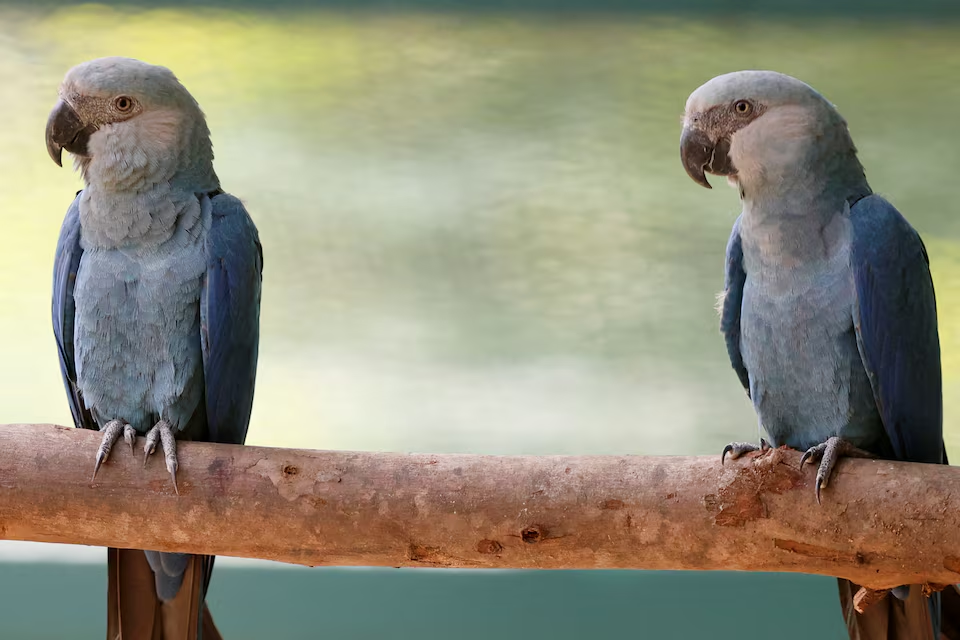
This is a story of a bird and a family. But it is no ordinary bird—and no ordinary family.
The Spix’s Macaw, a striking bright-blue parrot with elaborate courtship rituals, was declared extinct in the wild in 2019. Since then, a small number have been reintroduced into their native Brazilian habitat through a captive breeding program.
For more than two years, officials across three continents have questioned why 26 of these rare birds ended up in a private Indian zoo operated by a philanthropic arm of the Ambani family, Asia’s richest dynasty.
This week, Indian investigators cleared the sanctuary of wrongdoing. But European regulators said they are closely monitoring exports to Vantara, while Brazil, Germany, and India continue discussions under a UN-administered body that oversees wildlife trade.
Spread across 3,500 acres in Gujarat, the Vantara Animal Rescue and Rehabilitation Centre says it houses nearly 2,000 species. Last year, the site doubled as the venue for pre-wedding festivities of billionaire Mukesh Ambani’s youngest son, Anant, attended by guests including Ivanka Trump and Mark Zuckerberg. The zoo, located near a Reliance oil refinery, was formally inaugurated in March by Indian Prime Minister Narendra Modi.
A Reuters review of 2,500 commercially available customs records shows that since 2022, the center has imported extraordinary species from countries including South Africa, Venezuela, the Democratic Republic of Congo, and the United Arab Emirates.
Its acquisitions read like a modern Noah’s Ark: 2,896 snakes, 1,431 turtles, 219 tigers, 149 leopards, 105 giraffes, 62 chimpanzees, 20 rhinos, and numerous reptiles, from spiny-tailed lizards to veiled chameleons.
The declared value of these shipments was $9 million—a figure a Vantara spokesperson said reflected freight and insurance charges, not payments for the animals themselves.
“These are not commercial transactions,” the spokesperson insisted. “No animal transferred to Vantara has ever involved financial compensation.”
In August, India’s Supreme Court instructed investigators to examine whether Vantara’s acquisitions and animal care complied with national law and the Convention on International Trade in Endangered Species (CITES). This week, the court confirmed investigators found no violations.
The Spix’s Macaw Dispute
At the center of the controversy are the Spix’s Macaws, which the park obtained in 2023 from the Association for the Conservation of Threatened Parrots (ACTP), a German nonprofit that had partnered with Brazilian authorities to breed the species.
Customs records viewed by Reuters show the birds were flown from Berlin to Ahmedabad on February 4, 2023, with insurance and freight costs of $969 per bird—totaling $25,194. Customs duties and $19,000 in local fees were waived under Indian practice.
Brazil, however, says it never authorized their transfer to India and raised objections in CITES meetings.
In a September 8 email to Reuters, Brazil’s Chico Mendes Institute for Biodiversity Conservation stated:
“Vantara Zoo is not yet part of the Spix’s Macaw population management program, which is a fundamental condition for official participation in conservation efforts. Currently, no Indian institution is involved in the program, so there is no reason for the birds to be sent to India.”
Brazil ended its partnership with ACTP last year, accusing the group of sending macaws abroad for “commercial transactions” without Brazilian consent. ACTP has previously denied any commercial intent. After Reuters sought comment, ACTP’s legal representatives in Germany reiterated in writing that the group received no payment for the transfer to India.
Vantara, meanwhile, maintains that the macaws’ arrival was “completely legal, non-commercial, and part of a conservation breeding arrangement with ACTP.”
India’s Central Zoo Authority declined to respond to questions.
Germany’s Federal Environment Ministry confirmed it approved the transfer to Vantara in 2023 “in good faith” but admitted it had not consulted Brazil at the time. After later discussions with Brazilian officials, Germany rejected a subsequent transfer request, citing the zoo’s lack of participation in the official population program. That decision, a ministry spokesperson said, is now the subject of legal proceedings.
Elephants and Popcorn
According to Vantara’s annual report, only 20% of the 6,355 animals received in the year ending March 2024 came from within India. In total, the sanctuary has imported species from 40 countries.
Satellite images from Maxar Technologies show the land transformed from barren ground in 2020 into manicured lawns and forest-like greenery.
On media tours, Anant Ambani has showcased kitchens stocked with premium ingredients to prepare juices, sweets, and even popcorn for elephants.
When Modi visited earlier this year, his office released an eight-minute video of him feeding lion cubs, elephants, rhinos, and giraffes. One photograph showed a Spix’s Macaw perched on his hand.
In CITES meetings held in Geneva in February, India defended Vantara as a “recognized center for conservation breeding.” Documents published ahead of the next meeting in November reflect ongoing scrutiny. CITES confirmed to Reuters that discussions are underway with Brazil, India, and Germany, and Brazil will provide the latest updates.
Still, European officials have signaled heightened oversight. Responding to a lawmaker’s concerns on August 1, EU Environment Commissioner Jessica Roswall said member states would give “special attention and more thorough scrutiny” to any export requests involving India and Vantara—a stance not previously reported.
This week, New Delhi judges released a summary of the Indian investigators’ findings.
Among them: export and import permits for the Spix’s Macaws were in order, and Vantara is now in early-stage talks with Brazil about possible “rewilding” efforts.
“Their discussions are at a preliminary stage,” the report concluded.