News
Gopal Kapoor: How Ancient Wisdom from the Sacred Land of Himachal Challenges Modern Science

The words science and faith are often seen as opposing forces. While science relies on facts, logic, and measurable data, faith is rooted in tradition, belief, and intuition. Yet, there are moments when these two paths intersect—when ancient knowledge and modern inquiry converge in unexpected ways.
Gopal Kapoor, hailing from the serene valleys of Himachal Pradesh, stands at the heart of this intersection. Drawing from the symbolic references found in ancient scriptures, Kapoor predicts weather patterns with astonishing accuracy—often months in advance.
While modern meteorology depends on satellites worth millions, complex algorithms, and data modeling, Kapoor’s forecasts rely solely on the hidden messages embedded in age-old texts. And time and again, his predictions have proven eerily precise.
The Limits of Modern Meteorology and Kapoor’s Accuracy
Weather science remains one of the most unpredictable fields. Studies show that forecasts made two days in advance are about 85% accurate, while predictions a month ahead drop to just 20%.
This was evident recently when the Director of the India Meteorological Department released a video stating that no rainfall was expected for the next three days. Yet, at the same time, heavy rains lashed the Kullu and Mandi regions—just as Kapoor had predicted.
Kapoor had earlier explained on social media that the air distance between Manali, Lahaul-Spiti, and Tibet is minimal, and with the monsoon reaching Tibet, cold and dry winds would soon enter the Himalayas. He warned this would signify a breach in the Great Himalayas’ protective barrier. What’s striking is that despite advanced satellites and scientific tools, experts failed to detect such a signal, whereas Kapoor had anticipated it months earlier.
Weather Science Hidden in Ancient Scriptures
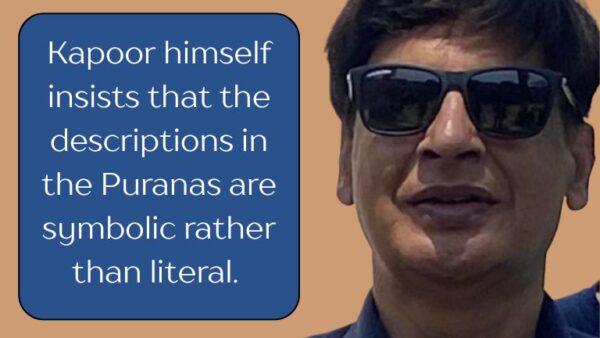
Kapoor himself insists that the descriptions in the Puranas are symbolic rather than literal. The messages need interpretation rather than word-for-word translation. He argues that Himachal Pradesh is the meteorological hub of India—controlling weather patterns across the subcontinent.
Interestingly, a century ago, the British had also made Shimla the headquarters of the Indian Meteorological Department before shifting it to Pune. This historical decision lends weight to Kapoor’s belief that Himachal’s geography holds significant meteorological importance.
India’s meteorological history spans thousands of years. The Vedas and Upanishads, dating back to 3000 BCE, discuss cloud formation, rainfall mechanisms, and seasonal changes influenced by the sun’s movement. Varāhamihira’s renowned text Bṛhatsaṃhitā (circa 500 CE) provides evidence that ancient scholars possessed deep insights into atmospheric processes.
Even the current Chairman of ISRO, S. Somanath, has acknowledged that concepts such as algebra, time, cosmology, metallurgy, and meteorology were first described in the Vedas—later transmitted through Arab scholars to Europe and emerging there as discoveries credited to the West.
It’s clear that the principles of weather science existed in ancient Indian texts millennia ago, long before Europe’s modern meteorology took shape in the 17th century with the invention of thermometers, barometers, and gas laws. What we now call science was once embedded in Vedic knowledge, though often dismissed by contemporary thinkers.
Modern Disasters Triggered by Human Interference
Kapoor also attributes recent natural disasters to reckless human intervention in the Himalayas’ ecological balance. He points to projects like the construction of ropeways in regions like Bijli Mahadev, which, he argues, disrupt nature and invite divine calamities.
While this may seem irrational to some scientists, their own analyses of disasters often point to excessive urbanization, infrastructural stress, and added weight on fragile mountain systems as causes of glacial melts and landslides. In essence, their conclusions mirror Kapoor’s observations.
Recently, Kapoor warned that in parts of Mandi, Kangra, Hamirpur, Bilaspur, and Chamba, the ‘soldiers of the Shankhachuda demon’ have spread—an allegorical statement that coincided with unexpected heavy rainfall in the region.
The Confluence of Ancient Wisdom and Modern Science
Though Kapoor’s predictions are often met with skepticism and controversy, one fact remains undeniable—he has revived a tradition of forecasting weather through scriptural insights. His work is not merely a personal talent but a testament to the profound meteorological knowledge encoded in India’s ancient texts.
When modern science falters despite satellites and sensors, the ability to interpret symbolic messages from the scriptures to predict accurate outcomes is remarkable. Rather than dismissing such insights, science should collaborate with individuals like Kapoor to explore how ancient knowledge can enrich contemporary research—potentially helping humanity prepare for and mitigate future disasters.
The wisdom of the past and the tools of the present may well hold the key to securing a safer tomorrow.