News
Intense “Instant Retail” Competition Among China’s Leading Online Firms Raises Fears of Falling Profits and Deflationary Pressures

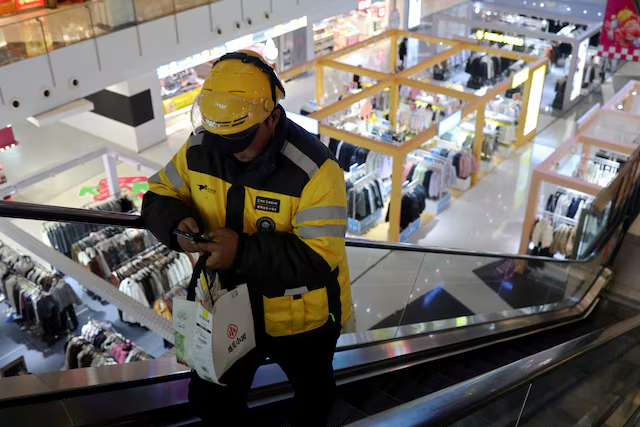
The fierce battle among China’s top online companies to dominate the “instant retail” space is expected to further erode their short- to medium-term profits and increase deflationary pressures in the world’s second-largest economy.
Companies like Alibaba (9988.HK), Meituan (3690.HK), and JD.com (9618.HK) are aggressively offering discounts, coupons, and other incentives to attract customers in the rapidly expanding one-hour delivery segment. This is draining their cash reserves, squeezing profit margins, and raising concerns among investors about the long-term viability of their strategies.
Regulators are also stepping up scrutiny, worried about falling prices in a market already strained by weak property values and unstable employment. These conditions are fueling consumer anxiety, prompting companies to further cut prices and offer subsidies in an effort to encourage spending.
In recent weeks, competition has dominated discussions among analysts and executives as e-commerce and food delivery firms announced their earnings for the quarter ending June 30.
JD.com CEO Sandy Xu warned of volatile “extreme competition,” while Meituan CEO Wang Jing pointed to a “new wave of competition.” Zhao Jiazhen, co-CEO of PDD Holdings (PDD.O), remarked that the rivalry is expected to “intensify throughout the quarter.”
Kenneth Fong, head of internet research at UBS Investment Bank China, commented, “The landscape is becoming increasingly challenging. It’s like a high-stakes game of ‘chicken,’ where the player who profits first risks wasting their initial investment. We expect this intense competition to last at least through the Singles’ Day shopping festival in November.”
S&P Global analysts estimate that Meituan, JD.com, and Alibaba will collectively spend at least 160 billion yuan ($22.37 billion) over the next 12–18 months to maintain or expand their market share in food delivery and instant retail. They warned of “significant declines” in profitability, adding that margin improvements are unlikely in the next 12–24 months.
Meituan is expected to suffer the most, as food delivery is its largest revenue source. Analysts noted that JD.com’s food delivery losses nearly wiped out its second-quarter profits, while Alibaba’s exposure is more limited, as instant retail accounts for only a small portion of its business.
For the current quarter, margin compression is expected as companies focus on sustaining e-commerce revenues through the end of June, bolstered by the mid-year ‘618’ shopping festival in China.
Despite the short-term pain, companies believe the investment will pay off in the long run. Jiang Fan, CEO of Alibaba’s e-commerce group, estimates that the instant retail segment could add 1 trillion yuan annually to Alibaba’s gross merchandise volume over the next three years.
Key metrics to watch in the second half of the year include how many instant retail users transition to the main e-commerce platforms. JD.com’s quarterly active customers rose over 40% year-on-year in Q2, while Alibaba’s Taobao app saw a 25% increase in monthly active users during the first three weeks of August, partly driven by food delivery user conversions.
While companies seem prepared for a prolonged battle, external forces may intervene to rein in the price wars.
Regulators have repeatedly warned platforms against racing to the bottom on prices. In July, Meituan, Alibaba, and JD.com issued statements promising to curb such practices.
Ying Wang, senior analyst at Moody’s Ratings, noted, “We expect that companies’ stated commitments to oppose investment-fueled price wars will gradually rationalize competitive dynamics.”
($1 = 7.1529 Chinese yuan renminbi)