News
Afghan Earthquake Survivors Refuse to Return to Villages Over Landslide Fears

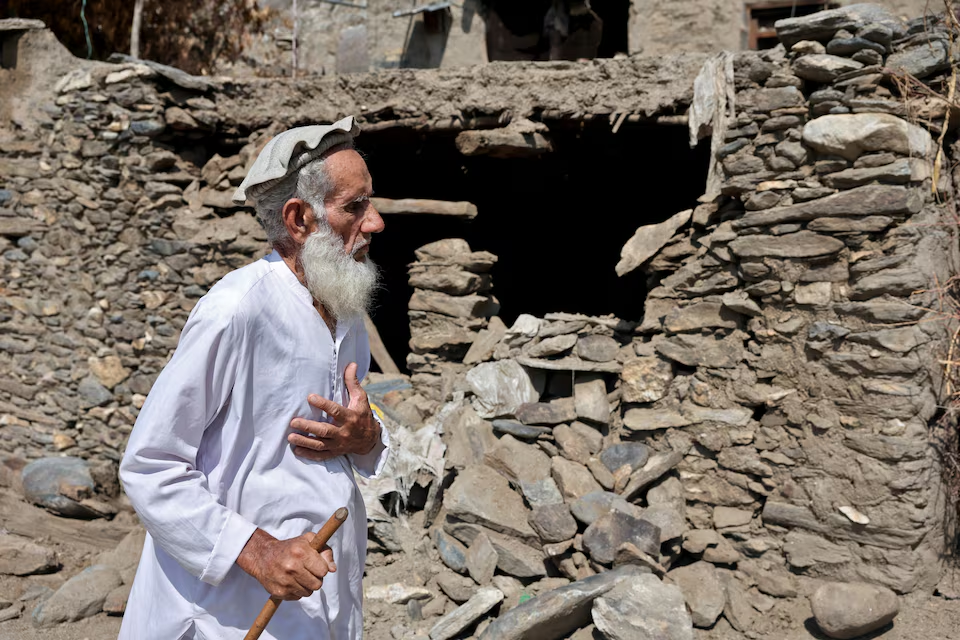
Fearing landslides triggered by aftershocks, Afghan earthquake survivors are refusing to return to their devastated villages. Instead, they are camping along fields and riverbanks — often without even tents to protect them from rain.
In Masood village of Kunar province in eastern Afghanistan, 67-year-old farmer Adam Khan stood by the ruins of his home, propped up by a wooden stick. “We have no shelter, not even a tent,” he said. The village was flattened by last week’s earthquake and its aftershocks.
“Last night it rained, and we had nowhere to hide,” he added. “Our greatest fear is those massive rocks that can fall at any moment.”
The twin earthquakes that struck on September 1 left more than 2,200 dead and over 3,600 injured across the region, destroying thousands of homes. Aftershocks caused further landslides, trapping families between unstable mountains and raging rivers.
Relief groups have airlifted food and supplies, but survivors say the aid is inconsistent and slow.
Afghanistan’s poverty and poor infrastructure make matters worse, with many villages hours away from the nearest road. Most homes — built from mud and stone — crumbled instantly during the tremors.
Families have gathered in makeshift camps scattered across the region. In Shahidan village, 40-year-old farmer Shams-ur-Rahman shared that six of his relatives had died. He and his nine-member family fled and now sit beside the road with their few belongings.
“The tents we were given are too small even for our children,” he explained. “When we descended the mountain, I didn’t have shoes for my son, so I took turns sharing mine with him.”
For some, displacement feels permanent. Gul Ahmad, 51, stood in the blazing sun near relatives sheltering in the shade of a wall, while their pop-up tents flapped weakly in the dust nearby.
“Even if there’s no earthquake, a small rain could bring stones crashing down on us,” he said. “We won’t go back. The government must give us a safe place.”
International aid agencies warn that without adequate shelter, sanitation, and food, this disaster could trigger further disease and poverty in one of the world’s poorest and most earthquake-prone countries.
Children are among the hardest hit. Twelve-year-old Sadiq was pulled alive from the rubble after being trapped for 11 hours. His grandmother and a cousin were killed beside him.
“I thought I was going to die,” he whispered, sitting silently on a rope cot as relatives moved around the family’s temporary shelter. “It felt like doomsday had come.”