News
How Tesla and Waymo’s Divergent Robotaxi Strategies Could Shape the Industry

Updated At : 15:58 PM Aug 28, 2025 IST
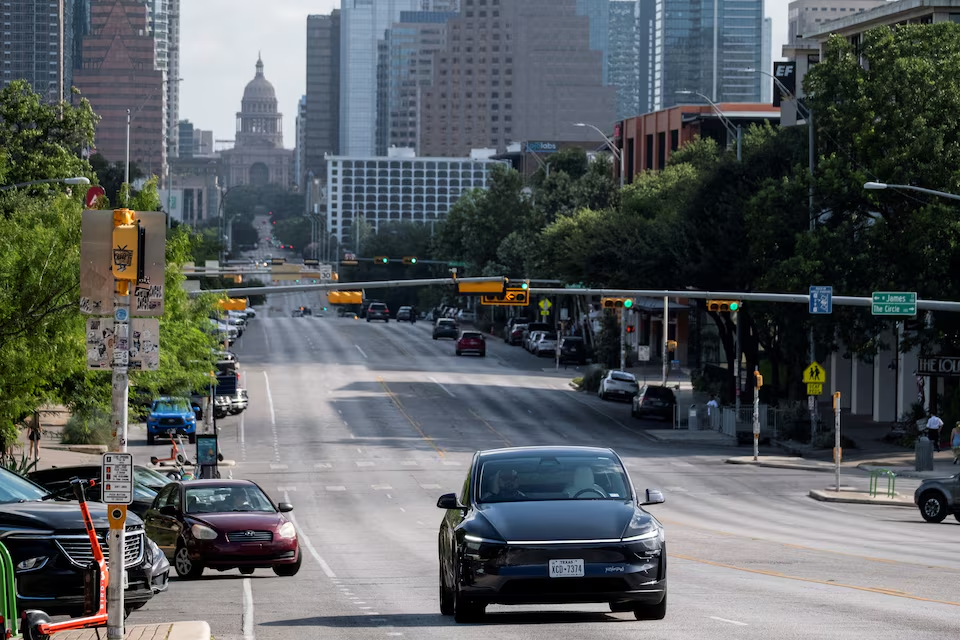
Just a month after Tesla (TSLA.O) launched a pilot robotaxi service for select fans in Austin, Texas, CEO Elon Musk told investors that the company’s driverless taxis would be available to “half the U.S. population” by the end of this year.
Alphabet’s Waymo (GOOGL.O), by contrast, began piloting a similar service in Phoenix more than eight years ago. Today, it operates in areas covering only about 3% of the U.S. population.
The two companies are pursuing sharply different strategies. Musk promises expansion at an “extremely exponential rate,” while Waymo has opted for a deliberate, market-by-market rollout.
Waymo relies on a rules-based system that integrates advanced sensors and high-definition mapping. Tesla, however, is betting on a leaner approach, depending solely on cameras and artificial intelligence to mimic human driving responses. Advocates of Musk’s strategy say it could allow far faster scaling, while critics warn that bypassing extensive testing and mapping carries risks. Analysts estimate the emerging autonomous driving sector could grow into a multi-trillion-dollar market within 15 years, making the stakes especially high.
Waymo’s method involves extensive mapping, safety validation in simulators, controlled testing on closed tracks, and gradual deployment with backup drivers before fully driverless rides. Tesla insists its AI-based system requires less groundwork, allowing it to scale more quickly once proven functional in a few cities.
Musk has dismissed Waymo’s approach as “fragile” and “limited in scalability,” but Waymo executives argue that understanding the unique conditions of each city—such as San Francisco’s steep hills or flood-prone streets in Austin—is essential for safety.
The contrast highlights a central question: is the future of robotaxis best served by rapid, AI-driven rollout or methodical, safety-first expansion? The answer may determine which company leads a market that could reshape transportation worldwide.