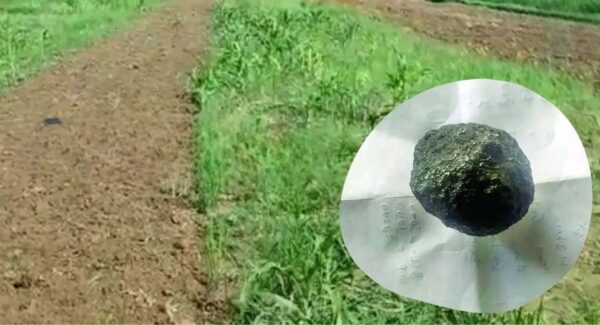
Ghumarwin, June 18 — A rare cosmic discovery in the Ghumarwin region of Bilaspur district, Himachal Pradesh, has sparked keen interest in the scientific community. While working in his fields in Jol village, located in the Lehri Sareli panchayat, retired school principal Sohan Lal Sharma stumbled upon a strange and striking object—later identified as a tektite, a rare form of natural glass believed to originate from meteorite impacts.
Sharma, who has previously been involved in fossil research, claims this is the first documented discovery of tektite in Himachal or any part of northern India. Tektites are known for their high value in international markets, often selling for lakhs of rupees due to their rarity and scientific significance.
What Are Tektites?
Tektites are glossy, black, glass-like stones formed from terrestrial material that melts during the high-energy impact of a meteorite. As molten rock is ejected into the atmosphere, it cools rapidly and solidifies into smooth, rounded glass fragments. Composed primarily of silica, iron, and aluminum, these objects are geological records of ancient celestial collisions.
The tektite found by Sharma is black, spherical in shape, approximately 5 cm in diameter, and weighs 32 grams.
An Open Call to Scientists
Sharma has invited geologists, archaeologists, and astrophysicists across India to study the find, believing it could significantly enhance understanding of the region’s geological history and past celestial activity. Tektites are often used in archaeological and geoscientific research, providing valuable insight into meteorite impacts and earth’s crustal evolution.
Notably, tektites have been found at archaeological sites across the globe, and their discovery in Himachal could place the region on the scientific map for further exploration and research.
Beyond its academic importance, the find also carries the potential to transform the local area into a center for scientific study and geo-tourism, opening new avenues for research and regional recognition.