Himachal Pradesh News
Donald Trump Warns ‘Whole Civilisation Will Die’ as US-Iran Tensions Escalate Over Strait of Hormuz Deadline
In a dramatic escalation of tensions in West Asia, Donald Trump issued a stark warning to Iran, cautioning that “a whole civilisation will die” if the ongoing crisis spirals out of control. His statement, posted on Truth Social, has intensified global concerns over a potential large-scale conflict in the region.

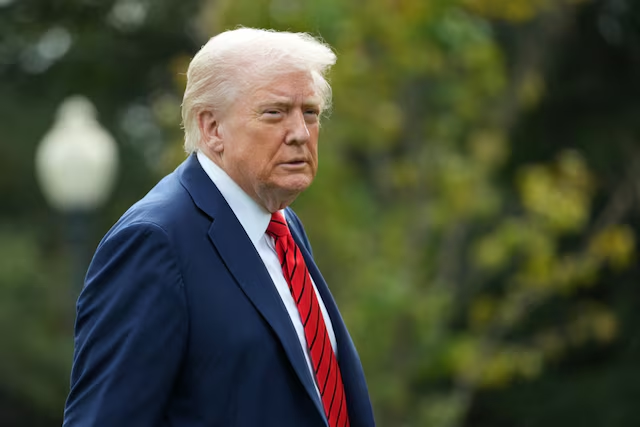
In a dramatic escalation of tensions in West Asia, Donald Trump issued a stark warning to Iran, cautioning that “a whole civilisation will die” if the ongoing crisis spirals out of control. His statement, posted on Truth Social, has intensified global concerns over a potential large-scale conflict in the region.
The warning comes just hours before a crucial US deadline related to the strategic Strait of Hormuz — a vital passage through which a significant portion of the world’s oil supply flows. Washington has warned Tehran of “severe consequences” if its demands are not met.
Despite the aggressive tone, Trump hinted at a slim possibility of diplomacy, suggesting that “something revolutionarily wonderful can happen,” indicating that backchannel talks may still be ongoing behind the scenes.
Iran Responds with Defiance
Iran, however, has responded firmly. President Masoud Pezeshkian struck a patriotic and defiant tone, asserting that millions of Iranians are prepared to defend their nation.
Echoing this stance, Iran’s Ambassador to India, Mohammad Fathali, warned that any attack on Iranian infrastructure would trigger a strong and lasting response. Iranian officials also invoked the country’s long history, emphasizing its survival through past invasions as a sign of resilience.
Meanwhile, the powerful Islamic Revolutionary Guard Corps (IRGC) declared that its “strategic patience” had ended, warning that any escalation could expand beyond the region and disrupt global energy supplies for years.
India Issues Advisory for Citizens
Amid the rising uncertainty, the Indian government has urged its nationals in Iran to exercise extreme caution. Authorities have advised citizens to remain indoors and avoid unnecessary travel as the situation continues to deteriorate.
According to official data, over 7.6 lakh passengers have travelled from West Asia to India since late February. The Indian Embassy in Tehran has already facilitated the safe movement of more than 1,800 Indian nationals to neighboring countries such as Armenia and Azerbaijan for onward journeys home.
However, a significant number of Indians are still believed to be in Tehran, raising concerns about their safety if tensions escalate further.
Military Actions and Global Concerns
Reports suggest that the US has carried out fresh strikes targeting Iran’s key oil hub at Kharg Island, further fueling fears of retaliation. At the same time, Iran has initiated domestic mobilisation efforts, urging citizens — including students, artists, and athletes — to form protective human chains around critical infrastructure.
Iranian Minister Alireza Rahimi described these facilities as “national assets,” warning that any attack on civilian infrastructure would be considered a war crime.
Signs of Internal Strain in Iran
Even as Iran projects strength externally, reports indicate growing internal tensions within its leadership. President Pezeshkian is believed to have raised concerns over unilateral actions by hardline elements within the security establishment, including figures linked to the IRGC.
Sources suggest that he has warned such moves could push the country toward “a huge catastrophe,” highlighting cracks within the decision-making structure during a critical moment.
A Region on Edge
With both sides exchanging sharp warnings and military signals intensifying, the situation in West Asia appears increasingly volatile. The coming hours — especially around the Strait of Hormuz deadline — are being closely watched by global powers, as any miscalculation could have far-reaching consequences for regional stability and the global economy.
For now, the world waits — caught between the hope of diplomacy and the fear of a conflict that could reshape the geopolitical landscape.