World News
Donald Trump Warns of Steeper Tariffs After Supreme Court Setback, Markets React to Trade Uncertainty
In a sharp escalation of trade rhetoric, US President Donald Trump on Monday warned that countries attempting to reconsider recently negotiated trade deals with the United States could face significantly higher tariffs.

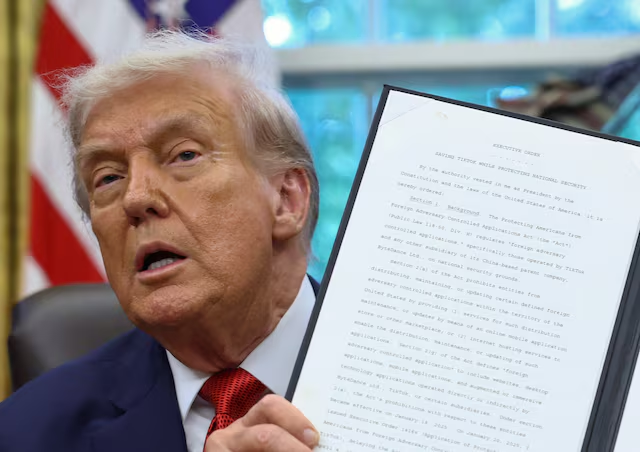
In a sharp escalation of trade rhetoric, US President Donald Trump on Monday warned that countries attempting to reconsider recently negotiated trade deals with the United States could face significantly higher tariffs.
His comments came just days after the Supreme Court of the United States struck down his emergency tariffs imposed under the International Emergency Economic Powers Act (IEEPA), creating fresh uncertainty around America’s global trade strategy.
“Buyer Beware”: Trump Signals Tougher Trade Stance
In a series of posts on Truth Social, Trump cautioned trading partners against what he described as “playing games” following the court’s ruling. He warned that any nation backing away from trade commitments would be met with “much higher” tariffs under alternative legal authorities.
Trump also hinted at the possibility of imposing new licence fees on trading partners, though he stopped short of offering specific details. According to him, while the court invalidated his emergency tariffs under IEEPA, it reaffirmed his authority to use other trade laws “in a much more powerful and legally certain way.”
The ruling, authored by Chief Justice John Roberts, emphasized the judiciary’s role in checking presidential power—an element that has added a constitutional dimension to the ongoing trade debate.
EU Delays Trade Vote Amid Fresh Tariff Shock
In Brussels, the European Parliament postponed a vote on a key EU-US trade agreement after Trump imposed a temporary 15% import duty on goods from all countries.
Under the proposed agreement:
- EU goods would face a 15% US tariff
- Exemptions would apply to food products, aircraft parts, critical minerals, and pharmaceutical ingredients
- The EU would remove duties on many US industrial goods
Trump initially introduced the temporary duty at 10% under Section 122 of the Trade Act of 1974 but quickly raised it to the maximum permitted 15%.
The new tariff is scheduled to take effect at 12:01 am EST on Tuesday. At the same time, US Customs authorities will stop collecting the now-illegal IEEPA-based duties.
Wall Street Reacts: Markets Close Lower
Trade uncertainty rippled through financial markets.
On Monday:
- The Dow Jones Industrial Average fell 1.65%
- The S&P 500 declined 1.02%
- The Nasdaq Composite dropped 1.01%
The US dollar also weakened against the euro and Japanese yen, reflecting investor nervousness.
Beyond tariffs, concerns about artificial intelligence-driven disruption in key industries further added to market volatility, amplifying investor caution.
Global Trade Talks in Limbo
The path forward remains uncertain:
- China urged Washington to roll back tariff measures.
- The European Union paused ratification of its trade agreement.
- India delayed planned trade talks.
Meanwhile, US Trade Representative Jamieson Greer signaled that the administration could launch new Section 301 investigations into alleged unfair trade practices—a move that could pave the way for additional tariffs.
On Capitol Hill, a group of 22 Democratic senators introduced legislation seeking refunds for tariffs previously collected under IEEPA. However, the proposal faces an unclear legislative future.
Bigger Constitutional and Political Questions
The Supreme Court ruling not only impacts trade policy but also reinforces judicial oversight over executive powers. Trump, who appointed two of the justices involved in the decision, criticized the ruling publicly.
He also expressed concern that the court could rule against his administration in a separate case concerning birthright citizenship, signaling that tensions between the executive branch and judiciary may continue.
What It Means for Global Businesses and Consumers
For businesses and investors, the message is clear: trade policy volatility is far from over.
- Companies dependent on global supply chains may face renewed cost pressures.
- Investors could see continued market swings.
- Consumers may ultimately bear the burden through higher import costs.
As legal battles, trade negotiations, and political tensions unfold simultaneously, the global economy is entering another period of heightened uncertainty.