World News
Donald Trump Says ‘Nothing Changes’ in India Trade Deal After US Supreme Court Blocks His Tariffs
In a dramatic political moment that could reshape America’s trade policy, former US President Donald Trump declared that “nothing changes” for India after the US Supreme Court struck down his sweeping global tariffs.

In a dramatic political moment that could reshape America’s trade policy, former US President Donald Trump declared that “nothing changes” for India after the US Supreme Court struck down his sweeping global tariffs.
Despite facing a major legal setback, Trump insisted that the India–US trade deal remains intact — and firmly in America’s favor.
Supreme Court Delivers a Blow to Trump’s Tariff Strategy
In a 6–3 ruling written by Chief Justice John Roberts, the US Supreme Court ruled that Trump overstepped his authority when he imposed broad tariffs on multiple nations under the International Emergency Economic Powers Act (IEEPA).
The court determined that the former president exceeded his legal powers, marking a significant challenge to one of the cornerstones of his economic policy during his second term ambitions.
Trump did not hold back.
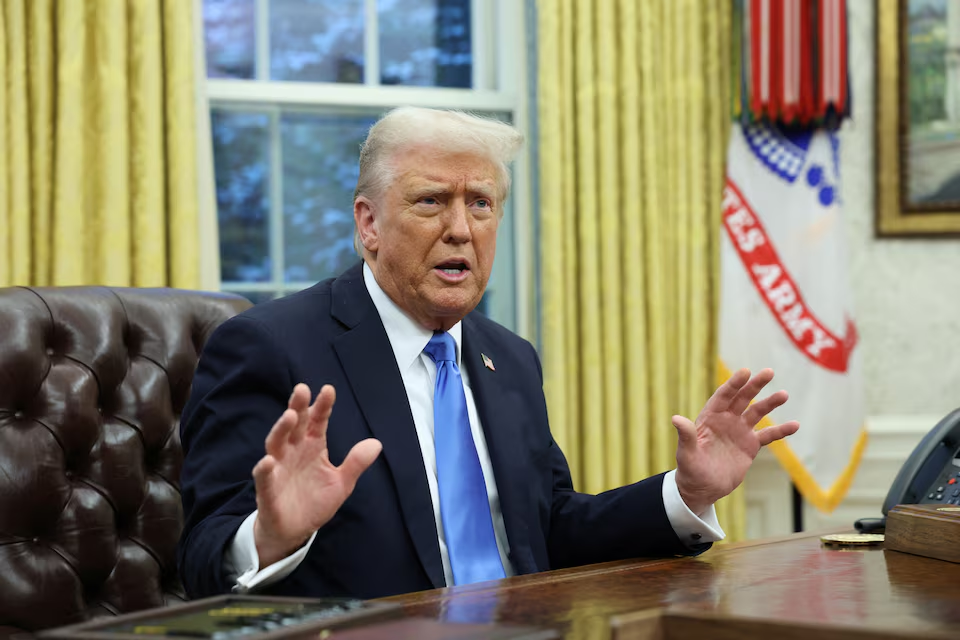
Speaking at the White House just hours after the verdict, he called the ruling “deeply disappointing” and criticized certain justices in strong terms. He thanked Justices Clarence Thomas, Samuel Alito, and Brett Kavanaugh for their dissenting opinions, praising what he described as their “strength and wisdom.”
‘Nothing Changes’ for India
Amid the controversy, Trump made one thing clear: the India trade deal remains unaffected.
“Nothing changes. They’ll be paying tariffs, and we will not be paying tariffs,” Trump said, emphasizing that the agreement represents what he calls a “fair reversal” of past trade imbalances.
The deal between the United States and India — announced earlier this month — includes a reduced reciprocal tariff rate. Washington agreed to lower tariffs on New Delhi from 25% to 18%, following commitments from India regarding energy imports and broader trade cooperation.
Trump also praised his relationship with Indian Prime Minister Narendra Modi, calling it “fantastic” and describing Modi as a “great gentleman.”
Executive Authority Still in Play?
Although the ruling limits tariff powers under IEEPA, Trump argued that it does not eliminate broader executive authority over trade. He signaled that alternative legal pathways could still allow future tariff measures.
In an assertive move following the verdict, Trump also announced an additional 10% global levy on certain imported goods, reinforcing his stance that tariffs remain central to his economic strategy.
Trump’s Claims on India–Pakistan and Russian Oil
During the press conference, Trump reiterated his controversial claim that he helped defuse tensions between India and Pakistan by leveraging tariff threats.
He also stated that India significantly reduced its purchases of Russian oil at his request — a move he framed as part of broader efforts to address geopolitical conflicts.
While these claims have drawn scrutiny internationally, Trump maintained that his trade policies have strengthened both America’s economy and its global influence.
He pointed to stock market milestones, including the Dow Jones Industrial Average crossing 50,000 and the S&P 500 reaching 7,000, as evidence that his economic strategy has delivered results.
What This Means for India–US Trade
For now, the interim India–US trade framework remains on track. Despite the Supreme Court ruling, both nations appear committed to moving forward under revised tariff terms.
The bigger question is whether Trump — if returned to office — could redesign his tariff approach using alternative legal mechanisms.
One thing is certain: trade remains at the heart of Trump’s political and economic narrative — and India continues to play a key role in that strategy.
Read Also : BJP Will Not Support Congress on Revenue Deficit Grant Issue: Jai Ram Thakur