World News
Donald Trump Says Iran Regime Change Could Be ‘Best Thing’ as Second US Aircraft Carrier Heads to Middle East
US President Donald Trump suggested regime change in Iran “could be the best thing” as the Pentagon deploys a second aircraft carrier to the Middle East amid renewed nuclear talks.

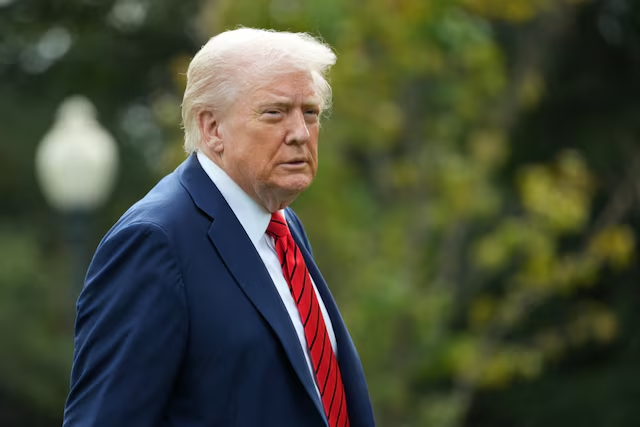
US President Donald Trump suggested regime change in Iran “could be the best thing” as the Pentagon deploys a second aircraft carrier to the Middle East amid renewed nuclear talks.
Washington: US President Donald Trump on Friday openly embraced the prospect of regime change in Iran, saying it “seems like that would be the best thing that could happen,” as the Pentagon ordered a second aircraft carrier to the Middle East.
The remarks come at a delicate moment when Washington and Tehran are attempting to revive diplomacy over Iran’s long-running nuclear dispute with Western powers.
Speaking after a military event at Fort Bragg, Trump accused Tehran of prolonged stalling tactics. “For 47 years, they’ve been talking and talking and talking,” he said, referencing decades of tensions between the two countries.
When asked who he would prefer to lead Iran in the event of regime change, Trump declined to specify but said, “There are people.”
Diplomacy in Parallel
Despite the strong rhetoric, negotiations appear to be underway. According to a source cited by Reuters, US envoys Steve Witkoff and Jared Kushner are scheduled to hold talks with Iranian representatives in Geneva on Tuesday, with Oman acting as mediator.
The envoys are also expected to meet Russian and Ukrainian officials in Geneva as part of US efforts to end the war in Ukraine.
Washington is pushing for any nuclear deal to also address Iran’s ballistic missile programme, its regional alliances with armed groups, and human rights concerns. Tehran, however, has indicated it is prepared to discuss only nuclear curbs in exchange for sanctions relief, rejecting broader linkages.
Trump has warned that military strikes remain an option if talks fail, while Iran has vowed retaliation — raising fears of a wider regional conflict.
Second Carrier Deployment
The Pentagon confirmed that the aircraft carrier USS Gerald R. Ford will deploy to the Middle East, joining the USS Abraham Lincoln and several guided-missile destroyers and fighter aircraft already positioned in the region.
The Gerald R. Ford — the newest and largest aircraft carrier in the US fleet — can carry more than 75 aircraft, including F/A-18 Super Hornets and E-2 Hawkeye early-warning planes. It also features advanced radar systems and nuclear-powered propulsion.
Supporting vessels include:
- USS Normandy
- USS Thomas Hudner
- USS Ramage
- USS Carney
- USS Roosevelt
Asked why a second carrier was being sent, Trump said: “In case we don’t make a deal, we’ll need it … if we need it, we’ll have it ready.”
US officials indicated the Ford would take at least a week to reach the Middle East.
Military Strain and Strategic Calculus
With only 11 aircraft carriers in the US arsenal, deployments are carefully scheduled and typically last around nine months. The Ford has been at sea since June 2025 and was originally scheduled for operations in Europe before being redirected to the Caribbean in November.
Extended deployments, Navy officials have cautioned, can affect crew morale and readiness.
The United States last positioned two aircraft carriers in the region in June last year, when it carried out strikes on Iranian nuclear facilities.
As diplomacy and deterrence unfold simultaneously, Washington’s dual-track strategy — negotiations backed by force — signals a high-stakes moment in US–Iran relations, with implications for regional stability and global energy security.
Read Also : Supreme Court Extends Deadline for Himachal Pradesh Local Body Polls to May 31