World News
Bangladesh Votes in Crucial General Election Amid Sporadic Violence
Bangladesh began voting in its 13th parliamentary elections — the first since Sheikh Hasina’s ouster — amid tight security and isolated violence. Nearly one million security personnel have been deployed nationwide.

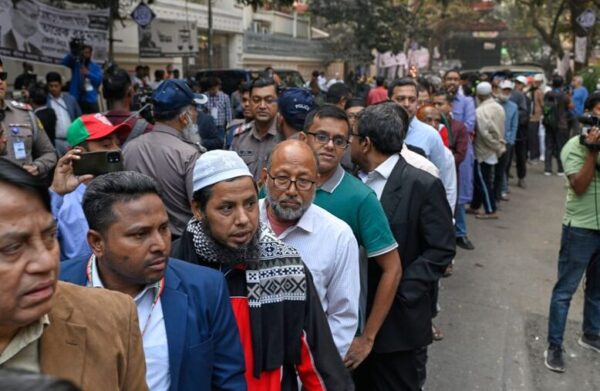
Bangladesh began voting in its 13th parliamentary elections — the first since Sheikh Hasina’s ouster — amid tight security and isolated violence. Nearly one million security personnel have been deployed nationwide.
Dhaka: Voting began on Thursday morning in Bangladesh’s crucial general election — the first since the ouster of former Prime Minister Sheikh Hasina following massive nationwide protests two years ago — amid reports of sporadic violence in parts of the country.
According to the Election Commission (EC), 32.88 per cent of votes had been cast across 32,000 polling centres nationwide by noon. The update was shared at a press briefing at 12:45 pm.
EC Senior Secretary Akhtar Ahmed said polling was continuing in all centres despite isolated incidents.
“So far, voting has not been suspended in any polling centre. There is no alarming situation,” he told reporters, as quoted by The Dhaka Tribune.
Voting began at 7:30 am (local time) in 299 of the 300 parliamentary constituencies and will continue until 4:30 pm. Counting is expected to begin shortly after polling concludes. Voting in one constituency was cancelled following the death of a candidate.
Tight Security Arrangements
The 13th parliamentary elections are being held alongside a referendum on an 84-point reform package.
Authorities have deployed nearly 900,000 to one million security personnel, marking the largest security arrangement in Bangladesh’s electoral history. Armoured Personnel Carriers (APCs) and Rapid Action Teams (RATs) have been stationed in key areas, including the capital Dhaka.
For the first time, drones and body-worn cameras are being used to monitor polling centres.
Police identified 1,614 of 2,131 polling centres in Dhaka as risk-prone, while the army classified two centres in the city as “risky”.
Reports of Violence
Despite extensive security, incidents of violence were reported from several districts.
In Gopalganj, three persons, including a 13-year-old girl, were injured in an alleged hand bomb attack at a polling station at Reshma International School in Nichupara around 9 am, according to BDnews24. Two members of the Ansar paramilitary force were among the injured. Officials said the injuries were minor and voting resumed shortly after.
In the Munshiganj-3 constituency, between 10 and 12 crude bombs were detonated outside the Makhati Gurucharan High School polling centre around 10:15 am, temporarily suspending voting for about 15 minutes. Polling later resumed.
In Khulna, a BNP leader, Mohibuzzaman Kochi (55), died following an altercation with Jamaat-e-Islami activists outside a polling station. The BNP alleged he was pushed into a tree, causing fatal injuries, while Jamaat claimed he fell ill during the unrest.
Political Contest
The election marks a significant political shift, with the Bangladesh Nationalist Party (BNP) emerging as a key contender in the absence of Sheikh Hasina’s now-disbanded Awami League, which was barred from contesting by Chief Adviser Muhammad Yunus’ interim government last year.
A total of 1,755 candidates from 50 political parties and 273 independents are contesting the polls. The BNP has fielded 291 candidates, the highest among parties. There are 83 female candidates.
Appeals for Peace
Chief Adviser Muhammad Yunus urged political parties and voters to exercise restraint and uphold democratic values.
Chief Election Commissioner AMM Nasir Uddin, in a televised address on the eve of polling, appealed to voters to cast their ballots freely and called on all stakeholders to maintain a peaceful atmosphere.
Representatives from 45 countries and organisations are observing the elections.
Nearly 127 million voters are eligible to cast ballots, including about 3.58 per cent first-time voters. For the first time, around 800,000 expatriate Bangladeshis registered with the Election Commission are able to vote through an IT-based postal ballot system.
The outcome of the election is expected to shape Bangladesh’s political and economic trajectory in the coming years.