Himachal Pradesh News
RDG cut could push Himachal Pradesh to fiscal brink, warns CM Sukhvinder Singh Sukhu
Himachal Pradesh Chief Minister Sukhvinder Singh Sukhu has warned that discontinuation of the Revenue Deficit Grant could trigger a deep fiscal crisis, forcing subsidy rollbacks, pension reforms and austerity measures.

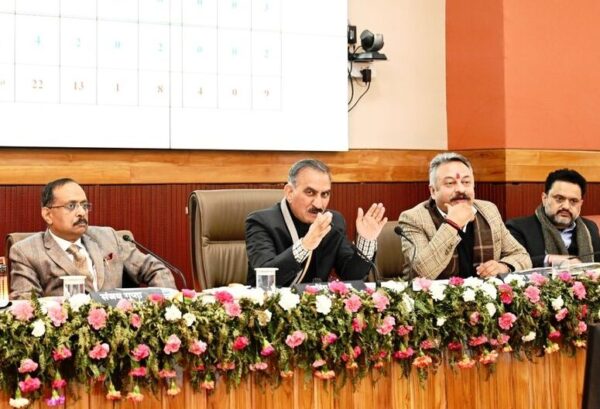
Himachal Pradesh Chief Minister Sukhvinder Singh Sukhu has warned that discontinuation of the Revenue Deficit Grant could trigger a deep fiscal crisis, forcing subsidy rollbacks, pension reforms and austerity measures.
Chief Minister Sukhvinder Singh Sukhu has warned that the failure to restore the Revenue Deficit Grant (RDG) or secure a special financial assistance package from the Centre could push Himachal Pradesh into a severe fiscal crisis, with the hill state facing an almost unbridgeable revenue–expenditure gap of nearly Rs 6,000 crore.
The warning followed a detailed presentation by the Finance Department before the Cabinet and Congress MLAs here on Sunday, outlining the state’s fragile financial position and the challenges likely to intensify if RDG support is withdrawn.
Sukhu cautioned that the discontinuation of RDG, pegged at Rs 37,199 crore, would have far-reaching consequences for governance and public welfare. He said the state may be forced to roll back key subsidies on electricity, water, subsidised ration and public transport, while a freeze on dearness allowance (DA) for government employees could become inevitable in the absence of fiscal space.
Explaining the structural constraints, the Chief Minister said Himachal Pradesh has been adversely affected in the post-GST regime, with tax collection growth slowing to around 8 per cent, compared to 13–14 per cent earlier. As a producer state, Himachal has been particularly vulnerable to the shift in taxation dynamics under GST.
The withdrawal of RDG may also compel the government to reconsider its pension framework. Sukhu indicated that the state could be forced to move from the Old Pension Scheme (OPS) to the Unified Pension Scheme (UPS) under the New Pension Scheme (NPS) to lift the Centre-imposed restriction on Rs 1,800 crore in additional borrowings.
Under the 16th Finance Commission recommendations, Himachal’s share in Central taxes has increased from Rs 11,500 crore to Rs 13,950 crore for 2026–27, a rise of Rs 2,450 crore, translating into a marginal increase of 0.084 per cent. The Finance Commission has also recommended Rs 2,682 crore for State and District Disaster Response Funds and Rs 4,179 crore for rural and urban local bodies. Additional relief has come through higher weightage for the cold desert region of Lahaul-Spiti and the state’s 66 per cent forest cover.
Principal Secretary (Finance) Devesh Kumar described Himachal Pradesh as a “chronically revenue-deficit state,” saying it was never designed to be economically self-sustaining and has historically relied on Central support. He warned that scrapping RDG would weaken cooperative federalism, erode fiscal autonomy and undermine the state’s capacity to deliver essential public services.
If the RDG lifeline snaps, Himachal may be forced into hard choices
- Pension reset: Migration from OPS to UPS under NPS to unlock the Rs 1,800 crore additional borrowing currently blocked by the Centre.
- Hiring freeze and workforce rationalisation: Abolition of vacant posts, suspension of fresh recruitment and restructuring of the existing workforce to curb salary expenditure.
- Shrinking the state’s institutional footprint: Downsizing or closure of up to 30 per cent of government institutions, along with mergers of departments, boards and corporations.
- Power sector privatisation: Opening up the Himachal Pradesh State Electricity Board/DISCOM to private participation to reduce long-term liabilities.
- Asset monetisation: Monetisation of state-owned land, buildings and other assets to generate non-tax revenue.
- Social security pension pruning: Reduction of the social security pension bill from Rs 1,661 crore to around Rs 500 crore through strict beneficiary verification.
- Dearness allowance freeze: Indefinite suspension of DA payments to government employees.
- Arrears on hold: No payment of DA or pay revision arrears to employees, and no release of dearness relief or pension revision arrears to pensioners.
- End of pension allowance: Possible discontinuation of pension allowance as part of expenditure compression.
- Subsidy rollback: Withdrawal or reduction of subsidies on power, water, ration and public transport.
Read Also : Himachal Pradesh apple growers oppose Centre’s US import deal, fear blow to local market