News
Israeli Bulldozers Undermine Palestinian Statehood Hopes in the West Bank

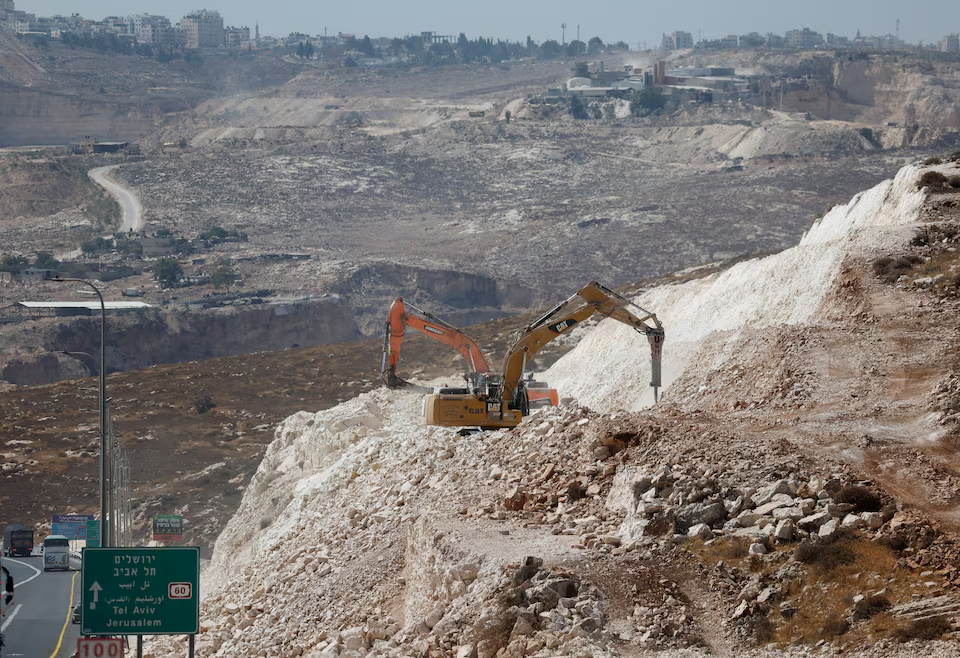
As U.S. President Donald Trump unveiled a plan this week to end the Gaza war and hinted at a possible path toward a Palestinian state, Ashraf Samara watched bulldozers rumble through his village in the Israeli-occupied West Bank—burying what hope he had left of statehood.
Surrounded by armed guards, Israeli machinery tore into land around Samara’s village of Beit Ur al-Fauqa to build new roads for Jewish settlements, carving up territory and adding fresh obstacles to Palestinian movement.
“This is meant to prevent residents from accessing and using this land,” said Samara, a member of the village council. The new roads, he told Reuters, will confine Palestinians “to their residential areas and villages.”
Each new road that eases access for Israeli settlers creates additional hurdles for Palestinians, who are often barred from using the routes, making it harder to reach nearby towns, workplaces, and farmland.
Settlements expand even as recognition of Palestine grows
While countries such as Britain and France joined a growing list of states recognizing Palestine in September, Israeli settlement expansion in the West Bank has accelerated under Prime Minister Benjamin Netanyahu’s government, against the backdrop of the Gaza war.
Palestinians and most of the international community consider settlements illegal under international law, a view Israel rejects.
Hagit Ofran of the Israeli activist group Peace Now said the new roads being carved near Beit Ur al-Fauqa represent a bid by Israel to consolidate control over more Palestinian land.
“They’re creating facts on the ground. As long as they have the power, they will spend the money,” she said, noting that Israel allocated seven billion shekels ($2.11 billion) for roadbuilding in the West Bank following Hamas’ October 2023 attacks that triggered the Gaza war.
Since Israel captured the West Bank in the 1967 war, settlements have spread deeper into the territory, supported by a network of Israeli-controlled roads and infrastructure.
In 2004, Israeli rights group B’Tselem described this network of settler roads and bypass routes as part of a “discriminatory road regime,” designed in part to physically block Palestinian urban development.
Netanyahu’s office and the Israeli military did not respond to requests for comment. Nor did the Yesha Council, which represents West Bank settlers.
Ahead of Trump’s Gaza plan, Netanyahu declared: “There will never be a Palestinian state.” He made the statement while approving a project to expand construction between the Ma’ale Adumim settlement and Jerusalem. His finance minister, Bezalel Smotrich, said the same project would “bury” the very idea of Palestinian statehood.
Trump’s plan to end the war, which Netanyahu has endorsed, does lay out a potential framework for a Palestinian state. But analysts argue that the conditions attached make such an outcome virtually unattainable.
“The government is now laying down the infrastructure for hundreds of thousands more settlers they want to bring to the West Bank,” said Ofran. “Without roads, they can’t do it. And once you build the road, the settlers will inevitably follow.”
($1 = 3.3199 shekels)