News
Government Shutdown Looms as Washington Deadlock Persists

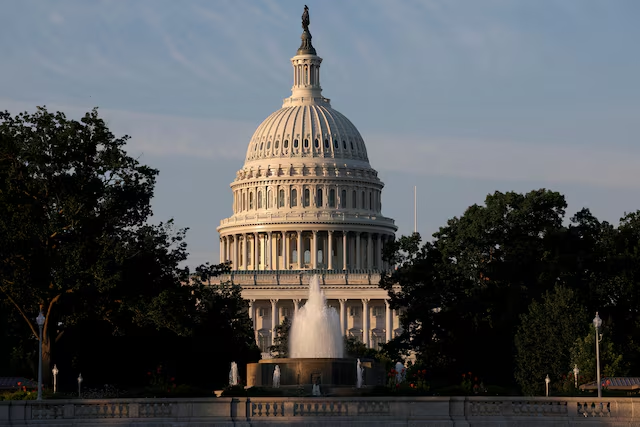
Washington braced Tuesday for a fast-approaching government shutdown, with little sign that Republicans and Democrats would strike a deal to keep federal funding flowing past the midnight deadline.
The Republican-controlled Senate is expected to vote on a stopgap spending bill that has already failed once, with no indication the second attempt will fare better. Democrats want to attach an extension of expiring health subsidies that benefit millions of Americans, while Republicans insist the issue be handled separately.
Meanwhile, federal agencies have rolled out contingency plans: offices handling scientific research, customer services, and other “non-essential” functions would close, and thousands of workers would be furloughed if no agreement is reached by midnight (0400 GMT Wednesday). Airlines warned of flight delays, and the Labor Department said it would suspend its monthly unemployment report — a closely watched economic indicator.
Democrats sought to drive a wedge between President Donald Trump and his Republican allies, pointing to his apparent openness in a White House meeting Monday to extending health tax credits for 24 million Americans. “It’s in the president’s hands whether we avoid a shutdown,” Senate Democratic leader Chuck Schumer said afterward.
Vice President J.D. Vance acknowledged that Democrats raised some “reasonable” points in the talks but said they should not threaten a shutdown to achieve their goals.
Any last-minute deal would also need approval from the Republican-led House, which is not scheduled to meet until Wednesday — after funding lapses.
Budget standoffs have become a fixture in Washington’s increasingly fractured politics, often resolved at the eleventh hour. The government last shut down for 35 days in 2018–19 during Trump’s first term, amid an immigration dispute.
At stake this time is $1.7 trillion in funding for agency operations, about a quarter of the $7 trillion federal budget. The bulk of spending goes to health and retirement programs, plus interest on the swelling $37.5 trillion national debt.
Layoff Threats Add Pressure
Uncertainty is heightened by Trump’s signals that he may ignore spending laws passed by Congress. He has threatened to move forward with federal layoffs if a shutdown occurs. Earlier this year, he directed agencies to weigh dismissing “non-essential” staff — employees typically furloughed during shutdowns.
“If Congress doesn’t do its job, you hand the executive branch a free hand,” warned Republican Senator Mike Rounds of South Dakota. “That’s a very good reason not to allow a shutdown.”
Trump has also refused to release billions already approved by Congress, leaving some Democrats questioning why they should back any funding bill at all. Though Republicans control both chambers, Senate rules mean they still need at least seven Democratic votes to pass legislation.
Alongside the health subsidies, Democrats have tried to ensure that any extensions couldn’t later be rolled back by Trump. They also pushed to restore funding to public broadcasting and other programs Trump cut, but dropped those demands Monday.
Still, Democrats — out of power in Washington and under pressure from frustrated supporters — see health care as a unifying issue that resonates strongly with voters ahead of the pivotal 2026 midterms.
But some question whether the shutdown gamble is worth it.
“This isn’t about politics or blame,” said Democratic Senator John Fetterman of Pennsylvania. “It’s about the damage this will cause to millions of Americans.”