News
Key Disputes Between Turkey and the U.S. After Trump–Erdoğan Meeting

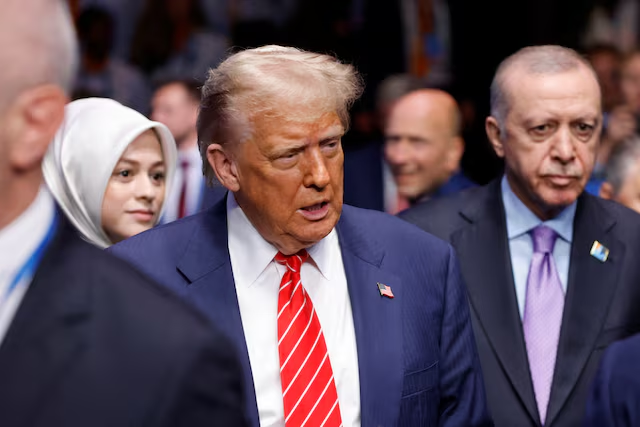
U.S. President Donald Trump will host his Turkish counterpart, Tayyip Erdoğan, at the White House on Thursday, where the two leaders are expected to discuss defense and trade agreements in an effort to ease longstanding diplomatic tensions between their countries.
While their personal rapport has helped reduce friction, several major issues continue to divide the NATO allies.
Defense and Sanctions
Turkey, NATO’s second-largest military power, is seeking compensation for its $1.6 billion investment in the F-35 fighter jet program, after Washington expelled Ankara from joint production and canceled its aircraft orders. The U.S. decision came in response to Turkey’s 2019 purchase of Russia’s S-400 missile defense system, which also triggered sanctions against its defense industry.
Erdoğan hopes his talks with Trump could pave the way for lifting sanctions and reopening access to advanced fighter jets. Meanwhile, Ankara has opposed Western sanctions on Moscow over the war in Ukraine, despite supplying Kyiv with drones and weapons. Any expansion of U.S. sanctions on Russia could strain Turkey’s economy, given its close energy ties with Moscow.
Israel and Hamas
The U.S. remains Israel’s closest ally, while Turkey has been among the fiercest critics of its Gaza operations—actions Erdoğan has described as “genocide.” Ankara has suspended trade with Israel, recalled its diplomats, and accused Prime Minister Benjamin Netanyahu’s government of obstructing regional peace.
Erdoğan has labeled Hamas, which governs Gaza, a “resistance movement.” By contrast, the U.S. and its Western allies classify it as a terrorist group, with Washington imposing sanctions on members of its political wing based in Turkey.
Syria
Syria remains one of the most complex disputes. Since the partial ouster of former president Bashar al-Assad by Turkish-backed rebels last December, Ankara and Washington have found greater alignment. Both now support the country’s new leader, former al-Qaeda figure Ahmad al-Shara, and back the creation of a strong central government.
Both sides have also urged the U.S.-backed, Kurdish-led Syrian Democratic Forces (SDF) to integrate with Damascus under a March agreement. But progress has been slow, leaving Turkey frustrated. Ankara considers the SDF a terrorist organization and has threatened a new military offensive in northern Syria, where hundreds of U.S. troops remain stationed alongside Kurdish fighters.
Trade and Tariffs
Trump’s second term has so far signaled a more positive outlook for bilateral trade. Although his administration imposed steep tariffs on several countries, Turkish goods were subject to a comparatively low 15% rate.
Earlier this week, Erdoğan’s office announced the removal of additional tariffs on certain U.S. imports. The move comes against the backdrop of lingering economic scars: in 2018, Trump’s steep tariffs on Turkish steel (50%) and aluminum (20%), imposed amid a dispute over a detained American pastor, were widely blamed for triggering Turkey’s worst financial crisis in decades. The Turkish lira has since lost nearly 90% of its value against the dollar, though much of the blame has also been directed at Erdoğan’s unorthodox economic policies.