News
In Himachal Pradesh, Pong Dam’s Water Level Rises 5 Feet Above Danger Mark Due to Heavy Rainfall

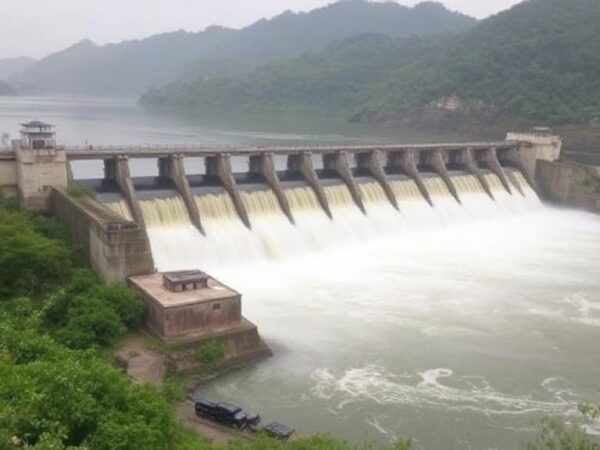
According to information released by the Bhakra Beas Management Board (BBMB), the water level of the Pong Dam on Wednesday morning was recorded at 1,395.17 feet, exceeding the prescribed upper limit of 1,390 feet by over 5 feet.
The excessive water level is a result of heavy rainfall in parts of Himachal Pradesh over the past few days, causing inflows into the dam, which is built across the Beas River.
As per the BBMB, the reservoir received an inflow of 74,960 cubic feet per second (cusecs), while 59,895 cusecs of water was released. Over the past decade, the average outflow during September has ranged between 9,622 cusecs and 14,852 cusecs.
The Pong Dam is located near the Punjab border in the Kangra district, with its catchment area spreading across the districts of Kullu, Mandi, and Kangra, where heavy rainfall has been recorded in recent days.
According to the India Meteorological Department (IMD), over the past week, rainfall in Mandi has been 457% above the long-term average, in Kangra 241% above, and in Kullu 34% above average levels. The IMD forecasts light to moderate rainfall in these districts until September 22.
For technical, weather-related, and safety reasons, the upper storage limit for the Pong Dam has been set at 1,390 feet, although the structure can safely accommodate up to 1,421 feet of water.
Meanwhile, the water level at the Bhakra Dam on the Sutlej River stood at 1,676.74 feet on Wednesday morning, remaining more than three feet below its maximum permissible level of 1,680 feet. The dam’s inflow was 35,999 cusecs, while the outflow was 50,000 cusecs.
BBMB officials stated that the water level at Bhakra is being maintained below the maximum limit as a precautionary measure to avoid sudden inflow increases in case of unexpected heavy rainfall in its catchment area.
Some experts have also noted that with the monsoon nearing its retreat phase and the official filling period of reservoirs coming to an end this month, the reservoirs are likely to be filled to their capacity. The period from October to May is typically one of water depletion, when inflows reduce due to lack of rainfall and gradual snowmelt.