News
Asian Stocks Hit Record Highs on Fed Expectations

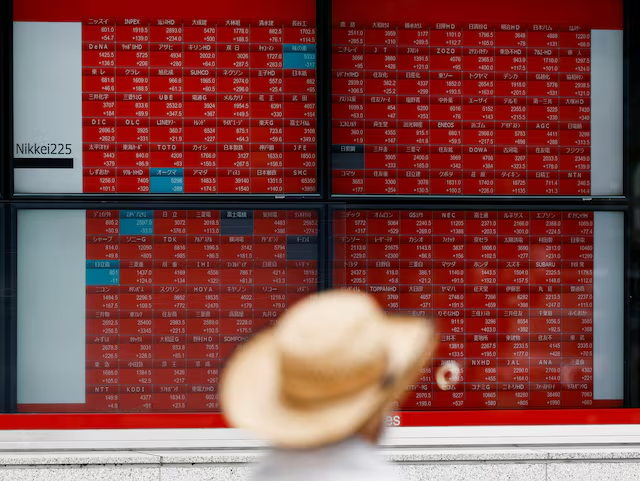
Following gains on Wall Street on Friday, Asian stock markets surged as expectations of faster interest rate cuts in the U.S. signaled lower global borrowing costs, relief for strained bond markets, and reduced pressure on the dollar.
The optimism extended to European shares, with Euro Stoxx 50 futures, FTSE futures, and DAX futures all rising by 0.2%. S&P 500 and Nasdaq futures remained steady after reaching new highs overnight.
Indices in Japan, South Korea, and Taiwan hit or hovered near record levels, while Chinese stocks climbed to their highest point in over three and a half years, driven by soaring expectations of AI-related earnings growth.
The upcoming U.S. consumer price report next week is seen as the last major hurdle for the Federal Reserve to begin cutting interest rates. Despite being slightly stronger than expected, it was still weak enough to support easing.
The cost component of the CPI—which feeds into the Fed’s preferred personal consumption expenditures (PCE) measure—remained soft. This led Citigroup analysts to forecast a steady annual rate of 2.9% for August. Citi economist Veronica Clark commented, “This is a reassuring signal for Fed officials preparing for a series of rate cuts.”
“We expect 125 basis points of rate cuts across the next five FOMC meetings, with growing risks that the Fed may extend cuts below 3%.”
Markets are pricing in a 100% probability of a quarter-point cut next week to 4.00%–4.25%, with nearly a 90% chance of two additional cuts this year.
Treasury markets have already adjusted, with 10-year yields falling by 20 basis points over the past two weeks—effectively signaling rate cuts since mortgage rates in the U.S. are linked to bond yields.
The decline also helped ease concerns in other major bond markets, particularly in Europe, where political uncertainty and rising fiscal burdens have weighed on sentiment.
In Asia, Japan’s Nikkei (.N225) climbed 1.0% to another all-time high, extending its weekly gain to 4.1%. South Korea’s KOSPI (.KS11) rose 1.3%, bringing its weekly increase to around 6%.
Chinese blue chips (.CSI300) remained steady, closing at their highest level since early 2022, while the MSCI Asia-Pacific index (.MIAPJ0000PUS), excluding Japan, jumped 1.2%.
ECB Holds Steady
In currency markets, the dollar pulled back to 147.40 yen after briefly touching 148.20 in the previous session. Finance ministers from Japan and the U.S. issued a joint statement on Friday confirming that neither country would target specific currency levels in their policies.
The euro remained stable at $1.1728 after modest gains on Thursday, following the European Central Bank’s decision to leave interest rates unchanged and signal that it remains in a “good position” on policy.
J.P. Morgan economist Greg Fucecsi noted, “This suggests the Governing Council is not inclined to ease rates without a significant shock to growth. As a result, we’ve pushed our forecast for the final rate cut from October to December.”
“We believe the ECB may have already eased rates, but the negative growth risks and inflation outlook still justify a dovish bias.”
Following the meeting, ECB sources told Reuters that December would likely be the most realistic timeframe to debate whether another cut is needed to support the economy.
Markets are pricing in only a one-in-five chance of a rate cut in December, with about a 60% probability that the ECB has already eased rates in this cycle.
Commodities
Gold rose 0.5% to $3,654 per ounce, just shy of the record high of $3,673.95 reached earlier this week.
Oil prices came under pressure after the International Energy Agency forecasted even larger supply gluts next year due to sustained overproduction by OPEC.
Brent crude dropped 0.6% to $65.91 per barrel, while U.S. crude fell 0.8% to $61.88 per barrel.