News
Special Report: India Likely to Increase Russian Oil Imports in September, Defying U.S. Pressure

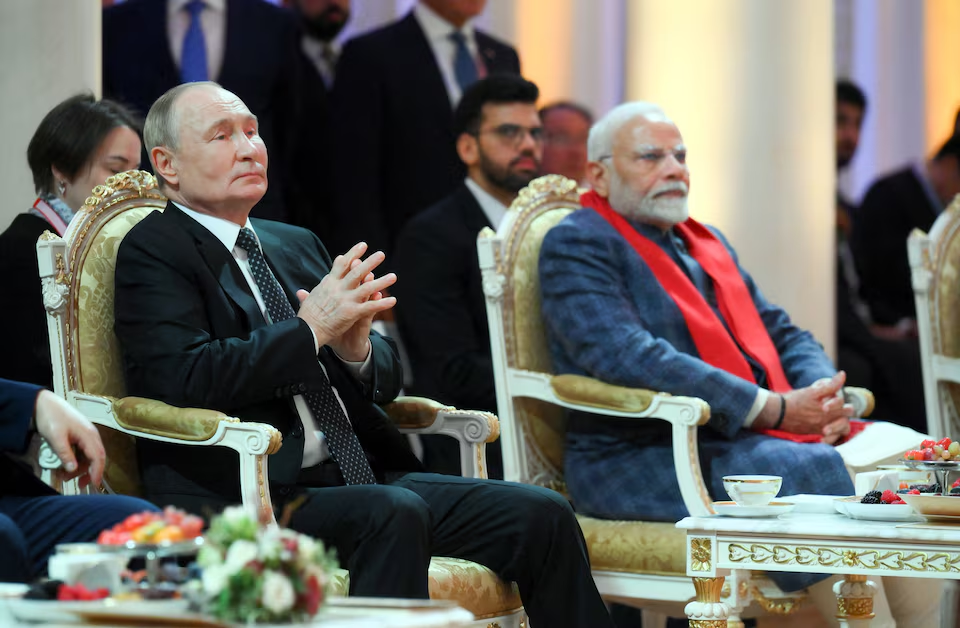
Dealers suggest that India is expected to step up Russian oil imports in September, disregarding Washington’s punitive tariffs aimed at curbing trade and pressuring Moscow toward a peace settlement with Ukraine.
Since the West imposed sanctions after Russia’s 2022 invasion of Ukraine, India has emerged as the single largest buyer of Russian oil, taking advantage of steep discounts that benefit its domestic refiners.
The U.S. administration of President Donald Trump has sharply criticized these purchases, raising tariffs on Indian imports to 50% on Wednesday. New Delhi, however, maintains that it will pursue dialogue to resolve the dispute, while Prime Minister Narendra Modi continues to strengthen diplomatic ties globally—including with Russian President Vladimir Putin.
American officials accuse India of profiting from discounted Russian oil, while Indian officials point to Western double standards, noting that the EU and U.S. still import billions of dollars’ worth of Russian goods.
BNP Paribas, in a research note, observed: “These tariffs are part of broader U.S.–India trade negotiations. Given India’s expanding refining sector and the appeal of discounted Russian barrels, we do not expect a significant reduction in India’s Russian imports.”
The Indian oil ministry declined to comment on Thursday.
Trade sources said Indian refiners are likely to raise Russian oil purchases by 10–20% in September—an additional 150,000–300,000 barrels per day compared with August levels. Reliance Industries and Nayara Energy (majority Russian-owned), India’s top buyers of Russian crude, did not respond to requests for comment.
Russia, facing reduced refining capacity after Ukrainian strikes disabled 10 refineries—about 17% of its processing output—now has additional crude available for export.
According to Vortexa data, India imported 1.5 million barrels per day (bpd) of Russian crude in the first 20 days of August, steady from July but slightly below the January–June average of 1.6 million bpd. This accounts for roughly 1.5% of global supply, making India the largest seaborne buyer of Russian crude and meeting about 40% of its domestic oil demand. China and Turkey are also major buyers.
India’s pivot to Russian oil has eroded OPEC’s share of its market in recent years, though OPEC’s position rebounded in 2024 after eight years of decline.
Traders said Russian exporters are offering Urals crude for September loading at discounts of $2–3 per barrel to dated Brent—deeper than the $1.50 discount seen in August, the lowest since 2022.
Sumit Ritolia of Kpler noted: “Unless India issues a clear policy shift or market economics change drastically, Russian crude will remain a cornerstone of its supply mix.”
Brokerage CLSA echoed this, stating that unless a global ban is enforced, India is unlikely to halt imports. If it did, the firm warned, global supply would shrink by about 1 million bpd, driving short-term prices back toward $100 per barrel.
Analysts expect the full impact of new U.S. tariffs and EU price caps to be felt only from October cargoes onward. The EU, for instance, will impose a $47.60 per barrel price ceiling on September 2—15% below Russian market rates—restricting Western services for cargoes sold above the cap.