News
Investors Worry Trump’s Intel Deal Marks the Dawn of a New U.S. Industrial Policy Era

Updated At : 11:41 AM Aug 28, 2025 IST
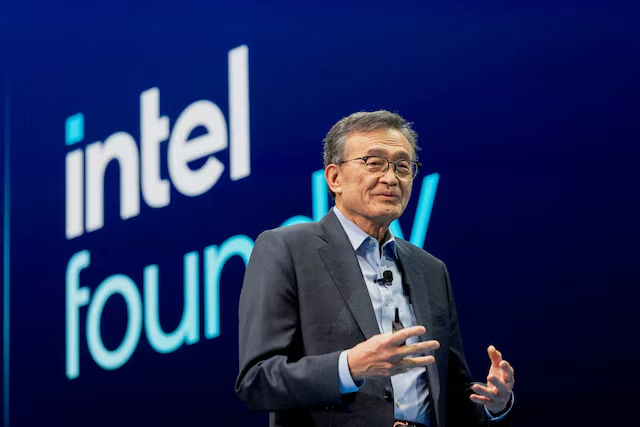
The U.S. government’s newly acquired stake in Intel (INTC.O) has rattled some investors, who fear President Donald Trump’s agreement signals a new era of government intervention in private industry. Their concerns were heightened by the fact that the deal came just days after Trump publicly called for the resignation of Intel’s CEO, Lip-Bu Tan.
Under the agreement, announced Friday, $11.1 billion in funding from the CHIPS Act and other federal sources will be converted into a 9.9% equity stake in Intel. A company press release announcing the deal featured statements of support from executives at Microsoft (MSFT.O), Dell (DELL.N), and other major firms.
Investors noted that such direct involvement is rarely seen in the traditionally arms-length relationship between Washington and corporate America. Trump, writing on social media, claimed Intel’s CEO wanted to keep his job and therefore “gave us $10 billion for the United States.”
Yet ratings agency Fitch said the transaction does not improve Intel’s BBB credit rating, which remains only one notch above junk status. In a research note Tuesday, Fitch wrote that while the deal boosts liquidity, it does little to improve fundamental demand for Intel’s chips.
Diluted Voting Power
Intel’s filings acknowledged that the agreement weakens existing shareholders by diluting their voting rights, and could subject the company to additional rules and restrictions abroad. CEO Tan also said Intel did not need the money, noting that SoftBank had invested $2 billion just three days before Trump’s announcement.
This move follows a series of recent, unusual White House interventions in private business, including a July defense-related deal involving a mining company stake and the influence exerted on U.S. Steel amid Japan’s Nippon Steel (5401.T) takeover. On Tuesday, U.S. Commerce Secretary Howard Lutnick suggested the administration might consider taking stakes in defense contractors as well.
Still, government ownership of corporate giants is common in Europe and Asia. Germany’s state of Lower Saxony, for example, holds 20% of Volkswagen (VOWG.DE).
“This has long been the norm in Japan, Korea, Taiwan, Singapore, and Malaysia,” said Richard Hardgree, vice chairman of technology investment banking at UBS. “Italy and France have built industrial policies around semiconductors for decades—40 or 50 years—ever since it became clear the sector was strategically vital.”
In the U.S., government equity stakes in private companies have been rare and typically short-lived, limited to rescue measures during the 2008–2009 financial crisis. A long-term shareholding in otherwise healthy firms, analysts noted, is without precedent—and it has unsettled investors.
Blurred Lines
“Rules and guardrails will be needed to limit opportunities for abuses such as insider trading,” said Rich Weiss, chief investment officer of multi-asset strategies at American Century Investments. “Unrestricted government equity participation could make trading in these companies far riskier for investors.”
Others raised similar concerns about conflicts of interest when boards weigh plant construction, layoffs, or foreign market expansion.
Robert McCormick, executive director of the Council of Institutional Investors, said such scenarios could put national interests at odds with shareholder interests.
“A government stake in a private company can create a clash between what’s best for the firm and what’s best for the country,” he said.
Kristin Hull, chief investment officer of California-based activist firm Nia Impact Capital—which manages Intel shares for its clients—said she has “more questions than confidence” about the deal. “We’re really blurring the line between government and the private sector,” she said.
Intel said its board had approved the share issuance, but declined to comment further. Asked about insider trading concerns, a spokesperson cited the company’s statement that the U.S. government would hold no board seats or governance rights. Microsoft declined to comment, while Dell did not respond to inquiries.
One major institutional investor, speaking anonymously, suggested the deal could shield Intel from activist investor pressure—but warned that if the government continues buying into corporations, it risks sliding toward state capitalism.
“For now, it’s eyebrow-raising, not alarming,” the investor said. “But if this becomes a broader pattern, we’ll need to ask why the government is stepping in instead of capital markets.”
James McRitchie, a California-based Intel shareholder activist, warned of the precedent being set. “If a president can strong-arm a CEO into giving up 10% of a company, that’s dangerous,” he said. “It sends the message: ‘Better play nice with Trump, or risk losing part of your firm.’”
On August 6, one day before Trump demanded Tan’s resignation, Intel shares closed at $20.41. By August 15, the last trading day before Trump’s terms became public, the stock had climbed to $24.56. On Tuesday, Intel slipped 1% to close at $24.35.
According to a securities filing, the deal does not grant the Commerce Department seats on Intel’s board. However, the department must support board nominees and proposals, and retains discretionary voting rights on other matters.